skimage.transform.warp takes a second argument, inverse_map, that accepts
four different kinds of object: a geometric transform, a bound .inverse
method, a bare (3, 3) array, a callable, and an array of coordinates. This
notebook shows what each one means, where they agree, and where they quietly
do not.
It is not about the name inverse_map. It is about the four things the
parameter accepts.
Coordinates are in array order unless a cell says otherwise: the first
number indexes the first array axis, which runs down the picture. Where warp
uses the other order, that is one of the findings.
import numpy as np
import matplotlib.pyplot as plt
from matplotlib.patches import Rectangle
from skimage.transform import warp, warp_coords, SimilarityTransform, ProjectiveTransformfatal: not a git repository (or any of the parent directories): .git
fatal: not a git repository (or any of the parent directories): .git
# Slots 1 to 3 of the reference categorical palette, validated all-pairs:
# worst CVD dE 9.2, worst normal-vision dE 24.0.
C_ONE = "#2a78d6"
C_TWO = "#eb6834"
C_THREE = "#1baf7a"
C_OFF = "#f2f1ec"
INK, MUTED, GRID = "#0b0b0b", "#52514e", "#dedcd5"

plt.rcParams.update(
    {"figure.dpi": 110, "font.size": 9, "axes.titlesize": 9,
     "axes.titlecolor": MUTED, "figure.facecolor": "white"}
)
Drawing helpers
def pixel_axes(ax, shape, title=None):
    """An empty pixel grid, axis 0 down and axis 1 right."""
    n_i, n_j = shape
    ax.set_xlim(-0.5, n_j - 0.5)
    ax.set_ylim(n_i - 0.5, -0.5)
    ax.set_xticks(range(0, n_j, 2))
    ax.set_yticks(range(0, n_i, 2))
    ax.set_xticks(np.arange(n_j + 1) - 0.5, minor=True)
    ax.set_yticks(np.arange(n_i + 1) - 0.5, minor=True)
    ax.grid(which="minor", color=GRID, linewidth=0.7)
    ax.tick_params(which="both", length=0, labelsize=7, colors=MUTED)
    ax.set_aspect("equal")
    for spine in ax.spines.values():
        spine.set_visible(False)
    if title is not None:
        ax.set_title(title)
    return ax


def fill(ax, image, color, threshold=0.5):
    """Fill every pixel of `image` above `threshold`."""
    for i, j in np.argwhere(image > threshold):
        ax.add_patch(Rectangle((j - 0.5, i - 0.5), 1, 1, facecolor=color,
                               edgecolor="white", linewidth=0.8, zorder=1))
    return ax


def spot(shape=(9, 9), at=(2, 3)):
    """A single bright pixel, so a displacement is unmistakable."""
    img = np.zeros(shape)
    img[at] = 1.0
    return img
1. The problem: one displacement, five spellings
Take a single bright pixel at (2, 3) and move the content down two rows,
to (4, 3). Every kind of argument can express that. They do not look alike.
img = spot()
ii, jj = np.indices(img.shape, dtype=float)

spellings = {
    "transform .inverse": SimilarityTransform(translation=(0, 2)).inverse,
    "transform object": SimilarityTransform(translation=(0, -2)),
    "(3, 3) matrix": np.array([[1.0, 0, 0], [0, 1, -2], [0, 0, 1]]),
    "callable": lambda c: c - np.array([0, 2]),
    "coordinate array": np.array([ii - 2, jj]),
}

fig, axes = plt.subplots(1, 5, figsize=(11.5, 2.3))
for ax, (name, arg) in zip(axes, spellings.items()):
    out = warp(img, arg)
    pixel_axes(ax, img.shape, name)
    fill(ax, img, C_OFF)
    fill(ax, out, C_ONE)
fig.suptitle("five arguments, one displacement (pale = before, blue = after)", y=1.04)
fig.tight_layout()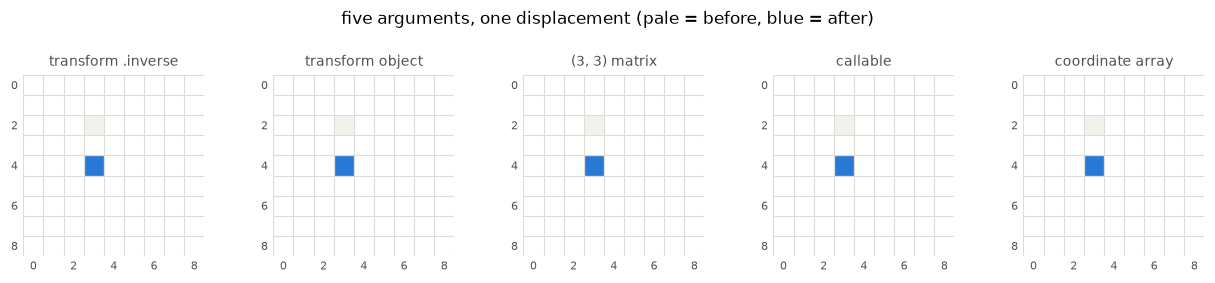
for name, arg in spellings.items():
    out = warp(img, arg)
    print(f"{name:<20} bright pixel now at {tuple(int(x) for x in np.argwhere(out > 0.5)[0])}")
transform .inverse bright pixel now at (4, 3)
transform object bright pixel now at (4, 3)
(3, 3) matrix bright pixel now at (4, 3)
callable bright pixel now at (4, 3)
coordinate array bright pixel now at (4, 3)
All five agree. The rest of this notebook is about what you had to know to write each one.
2. The contract they share
Every kind answers the same question: for this output pixel, where in the input image do I sample? So the map runs from output coordinates to input coordinates.
That is easy to assert and easy to get backwards, so measure it. Give the output a different shape from the input, then record what a callable is handed.
seen = {}

def spy(coords):
    """Record what warp passes in, then act as the identity."""
    seen["shape"] = coords.shape
    seen["min"], seen["max"] = coords.min(axis=0), coords.max(axis=0)
    return coords


warp(np.zeros((9, 9)), spy, output_shape=(5, 20))
print("input image shape (9, 9), output_shape (5, 20)")
print(f"   the callable was handed {seen['shape']}")
print(f"   component 0 spans {seen['min'][0]:.0f} .. {seen['max'][0]:.0f}")
print(f"   component 1 spans {seen['min'][1]:.0f} .. {seen['max'][1]:.0f}")
print()
print("an input grid would span 0..8 in both; an output grid spans 0..19 and 0..4")
input image shape (9, 9), output_shape (5, 20)
the callable was handed (100, 2)
component 0 spans 0 .. 19
component 1 spans 0 .. 4
an input grid would span 0..8 in both; an output grid spans 0..19 and 0..4
100 is 5 times 20. The callable is walked over the output grid and must return input coordinates. The direction is fixed for every kind of argument.
3. The coordinate array
The array is that map written out in full: its shape spans the output, and its values are coordinates in the input image. Point every entry at one input pixel and the whole output takes that pixel’s value.
ramp = np.arange(81, dtype=float).reshape(9, 9)
coords = np.zeros((2, 5, 20))
coords[0], coords[1] = 2, 3          # every output pixel samples input (2, 3)
out = warp(ramp, coords)
print(f"ramp[2, 3] = {ramp[2, 3]}")
print(f"array shape {coords.shape} -> output shape {out.shape}")
print(f"every output value is {np.unique(out)}")
ramp[2, 3] = 21.0
array shape (2, 5, 20) -> output shape (5, 20)
every output value is [21.]
This is the only kind of argument that carries no convention of its own. It is plain array-order indices, and it is unaffected by any change to the coordinate convention elsewhere in the library.
4. The callable, and the axis order that flips
The callable is the same map, computed rather than tabulated. warp_coords
converts one into the other, and the two routes agree exactly.
def f(c):
    return c - np.array([0, 2])


print("warp(img, f) == warp(img, warp_coords(f, shape)):",
      np.allclose(warp(img, f), warp(img, warp_coords(f, img.shape))))
warp(img, f) == warp(img, warp_coords(f, shape)): True
But the two forms do not use the same axis order. The callable receives
(column, row) pairs. The coordinate array is indexed (row, column). So the
same expression, written the same way, means different things.
same_expression = {
    "callable: c - [0, 2]": lambda c: c - np.array([0, 2]),
    "array: [ii, jj - 2]": np.array([ii, jj - 2]),
}
fig, axes = plt.subplots(1, 2, figsize=(5.6, 2.4))
for ax, (name, arg) in zip(axes, same_expression.items()):
    out = warp(img, arg)
    at = tuple(int(x) for x in np.argwhere(out > 0.5)[0])
    pixel_axes(ax, img.shape, f"{name}\n-> {at}")
    fill(ax, img, C_OFF)
    fill(ax, out, C_TWO)
fig.suptitle("subtract 2 from component 1, both ways", y=1.06)
fig.tight_layout()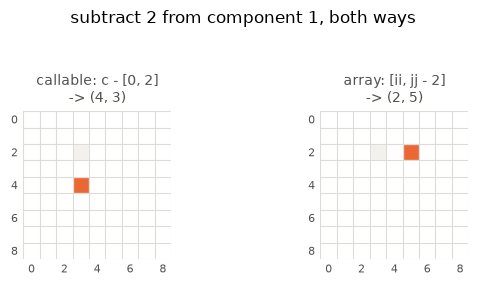
One moves the content down, the other moves it right. warp_coords is the
bridge that performs the flip, which is why the two routes still agree when you
go through it.
5. The transform object
A transform object is the only kind that carries a direction of its own, and
warp uses it as the output-to-input map. So a transform built to describe
where the content should go has to be inverted first.
down_two = SimilarityTransform(translation=(0, 2))   # (x, y): move content down
for name, arg in (("passed directly", down_two), ("passed as .inverse", down_two.inverse)):
    at = tuple(int(x) for x in np.argwhere(warp(img, arg) > 0.5)[0])
    print(f"SimilarityTransform(translation=(0, 2)) {name:<19} -> {at}")
SimilarityTransform(translation=(0, 2)) passed directly -> (0, 3)
SimilarityTransform(translation=(0, 2)) passed as .inverse -> (4, 3)
fig, axes = plt.subplots(1, 2, figsize=(5.6, 2.4))
for ax, (name, arg) in zip(axes, (("passed directly", down_two),
                                  ("passed as .inverse", down_two.inverse))):
    out = warp(img, arg)
    at = tuple(int(x) for x in np.argwhere(out > 0.5)[0])
    pixel_axes(ax, img.shape, f"{name}\n-> {at}")
    fill(ax, img, C_OFF)
    fill(ax, out, C_THREE)
fig.suptitle("SimilarityTransform(translation=(0, 2)), two ways", y=1.06)
fig.tight_layout()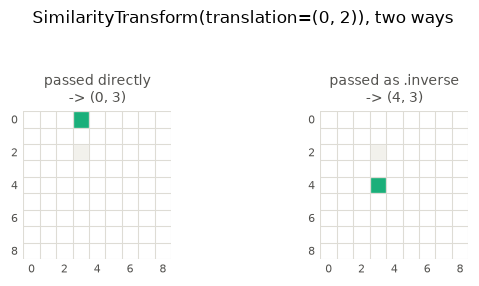
The object and its inverse are both accepted, both are spelled almost the same way at the call site, and they move the content in opposite directions. Which one is correct depends entirely on what the caller meant when they built it.
6. The bare matrix
What a homogeneous matrix is
A D-dimensional affine map has two parts: a linear part that can rotate,
scale and shear, and a translation that can only be added. Matrix
multiplication alone cannot add a constant, so the coordinate is augmented
with a trailing 1, and the matrix is grown to (D + 1, D + 1) to match:
    | a  b  tx |   | x |     | a*x + b*y + tx |
    | c  d  ty | . | y |  =  | c*x + d*y + ty |
    | p  q   s |   | 1 |     | p*x + q*y + s  |
The blocks have distinct jobs:
the top-left
DbyDblock is the linear part;the last column is the translation, which the augmented
1turns into an addition;the last row is the projective part. For an affine map it is
(0, ..., 0, 1), so the trailing component stays1and can be discarded. When it is anything else, the result is divided by that component, which is what makes perspective possible.
The two roles are visible directly. An entry in the last column shifts one axis:
for entry, label in (((0, 2), "M[0, 2]"), ((1, 2), "M[1, 2]")):
    m = np.eye(3)
    m[entry] = -2
    out = warp(img, m)
    print(f"{label} = -2 moves the pixel from (2, 3) to "
          f"{tuple(int(x) for x in np.argwhere(out > 0.5)[0])}")
M[0, 2] = -2 moves the pixel from (2, 3) to (2, 5)
M[1, 2] = -2 moves the pixel from (2, 3) to (4, 3)
So the first homogeneous row is the column axis and the second is the
row axis: the matrix is written in (x, y) order, like the callable of
section 4 and unlike the coordinate array of section 3.
An entry in the last row divides, and evenly spaced inputs stop being evenly spaced:
projective = np.eye(3)
projective[2, 0] = 0.05           # the trailing component now depends on x
points = np.array([[0.0, 0], [10, 0], [20, 0]])       # (x, y) row vectors

print("input  x:", points[:, 0])
print("output x:", np.round(ProjectiveTransform(projective)(points)[:, 0], 3))
print("an affine matrix would have left the spacing alone")
input x: [ 0. 10. 20.]
output x: [ 0. 6.667 10. ]
an affine matrix would have left the spacing alone
It is recognised by its shape, and the shape is ambiguous
warp decides that an array is a matrix by testing shape == (3, 3). It never
consults the image, so a 3-D image gets the same answer as a 2-D one.
cube = np.arange(125, dtype=float).reshape(5, 5, 5)
print("2-D image + (3, 3) array -> homography:",
      tuple(int(x) for x in np.argwhere(warp(img, np.eye(3)) > 0.5)[0]))
print("3-D image + (3, 3) array -> output shape", warp(cube, np.eye(3)).shape)
2-D image + (3, 3) array -> homography: (2, 3)
3-D image + (3, 3) array -> output shape (5, 5, 5)
That second line is the problem. For a 3-D image a (3, 3) array is also a
perfectly good coordinate array: three components over an output of shape
(3,), which would have produced an output of shape (3,). There is no way to
ask for it.
coords_3 = np.zeros((3, 3))
coords_3[:, 0] = [1, 2, 3]        # three components, output shape (3,)
print("meant as coordinates, output shape would be (3,); got",
      warp(cube, coords_3).shape)
meant as coordinates, output shape would be (3,); got (5, 5, 5)
The collision is not between the two kinds of array. It is between two readings
of the same image: warp treats any 3-dimensional input as 2-D with channels,
because it has no way to be told otherwise.
rgb = np.zeros((9, 9, 3))
rgb[2, 3, :] = 1.0
shift = np.eye(3)
shift[1, 2] = -2
print("(9, 9, 3) as 2-D with channels ->",
      tuple(int(x) for x in np.argwhere(warp(rgb, shift)[..., 0] > 0.5)[0]))
print("(5, 5, 5) is read the same way, though it is a volume")
(9, 9, 3) as 2-D with channels -> (4, 3)
(5, 5, 5) is read the same way, though it is a volume
With channel_axis, the ambiguity disappears
Suppose warp gains a channel_axis, as the rest of the library has. Then the
spatial dimensionality S is known rather than guessed, and the two kinds
of array separate by their leading axis alone:
print(f"{'S':>3}{'homogeneous matrix':>22}{'coordinate array':>24}{'leading axes':>14}")
for S in range(1, 6):
    print(f"{S:>3}{str((S + 1, S + 1)):>22}{f'({S}, *output_shape)':>24}"
          f"{f'{S + 1} vs {S}':>14}")
S homogeneous matrix coordinate array leading axes
1 (2, 2) (1, *output_shape) 2 vs 1
2 (3, 3) (2, *output_shape) 3 vs 2
3 (4, 4) (3, *output_shape) 4 vs 3
4 (5, 5) (4, *output_shape) 5 vs 4
5 (6, 6) (5, *output_shape) 6 vs 5
A matrix leads with S + 1 and coordinates lead with S. They differ by one
at every dimensionality, so the test is exact and needs no special case:
def kind_of(arr, image, channel_axis=None):
    """Is this array a homogeneous matrix, or an array of coordinates?"""
    spatial = image.ndim - (channel_axis is not None)
    if arr.shape == (spatial + 1, spatial + 1):
        return "homogeneous matrix"
    if arr.shape[0] == spatial:
        return "coordinate array"
    raise ValueError(
        f"array of shape {arr.shape} is neither a "
        f"{(spatial + 1, spatial + 1)} matrix nor coordinates for {spatial} axes"
    )


cases = [
    ("(9, 9) image,      (3, 3) array", np.eye(3), img, None),
    ("(9, 9, 3) rgb,     (3, 3) array", np.eye(3), rgb, -1),
    ("(5, 5, 5) volume,  (3, 3) array", np.eye(3), cube, None),
    ("(5, 5, 5) volume,  (4, 4) array", np.eye(4), cube, None),
]
for label, arr, image, axis in cases:
    print(f"{label:<34} -> {kind_of(arr, image, axis)}")
(9, 9) image, (3, 3) array -> homogeneous matrix
(9, 9, 3) rgb, (3, 3) array -> homogeneous matrix
(5, 5, 5) volume, (3, 3) array -> coordinate array
(5, 5, 5) volume, (4, 4) array -> homogeneous matrix
The same (3, 3) array is a matrix for an RGB image and a coordinate array for
a volume. channel_axis is the whole of what distinguishes them.
And then the matrix stops being 2-D only
Once S is known, nothing about a homogeneous matrix is specific to two
dimensions: (4, 4) describes a 3-D affine map in the same way (3, 3)
describes a 2-D one. What blocks it today is not the matrix but warp_coords,
which is written for two axes. Given a coordinate builder that is not, a
(4, 4) matrix behaves as it should.
import scipy.ndimage as ndi
from skimage.transform import AffineTransform


def warp_coords_nd(coord_map, shape):
    """`warp_coords` with no dimensionality assumption, in array order."""
    coords = np.indices(shape, dtype=float).reshape(len(shape), -1).T
    return coord_map(coords).T.reshape((len(shape),) + tuple(shape))


volume = np.zeros((8, 9, 10))
volume[2, 3, 4] = 1.0
M4 = np.eye(4)
M4[:3, 3] = [1, 0, 0]              # shift one step along the first axis

moved = ndi.map_coordinates(volume, warp_coords_nd(AffineTransform(matrix=M4),
                                                   volume.shape), order=1)
print("(4, 4) matrix moves the voxel to",
      [tuple(int(x) for x in p) for p in np.argwhere(moved > 0.5)], "from (2, 3, 4)")
print("scipy.ndimage.affine_transform agrees:",
      [tuple(int(x) for x in p)
       for p in np.argwhere(ndi.affine_transform(volume, M4, order=1) > 0.5)])
(4, 4) matrix moves the voxel to [(1, 3, 4)] from (2, 3, 4)
scipy.ndimage.affine_transform agrees: [(1, 3, 4)]
Section 8 shows what warp does with that same (4, 4) matrix today.
7. What each kind supports
The kinds are not interchangeable in what they accept alongside them.
def shift_rows(c, dy=0):
    return c - np.array([0, dy])


def moved_to(arg, **kwargs):
    """Where the bright pixel ends up."""
    out = warp(img, arg, **kwargs)
    return tuple(int(x) for x in np.argwhere(out > 0.5)[0])


print("callable + map_args         ->", moved_to(shift_rows, map_args={"dy": 2}))
print("coordinate array + map_args ->",
      moved_to(np.array([ii, jj]), map_args={"dy": 2}), " (ignored)")
callable + map_args -> (4, 3)
coordinate array + map_args -> (2, 3) (ignored)
map_args is meaningful only for the callable. Passing it with any other kind
is silently accepted and does nothing, except that it also disables the fast
Cython path.
8. Three dimensions
Only the coordinate array works in N-D. The others are documented as 2-D, but the failure is not always a message.
from skimage.transform import AffineTransform

M4 = np.eye(4)
M4[:3, 3] = [1, 0, 0]
t3 = AffineTransform(matrix=M4)
vol = np.zeros((8, 9, 10))
vol[2, 3, 4] = 1.0

grid = np.indices(vol.shape, dtype=float)
grid[0] -= 1
print("coordinate array, 3-D  ->",
      [tuple(int(x) for x in p) for p in np.argwhere(warp(vol, grid) > 0.5)])

out = warp(vol, t3, order=1)
found = np.argwhere(out > 0.5)
print("3-D transform, order=1 ->",
      [tuple(int(x) for x in p) for p in found], " (nothing: the voxel is gone)")
try:
    warp(vol, t3, order=0)
except Exception as e:
    print("3-D transform, order=0 ->", type(e).__name__)
try:
    warp(vol, M4)
except Exception as e:
    print("(4, 4) matrix          ->", type(e).__name__, "-", str(e)[:44])
coordinate array, 3-D -> [(3, 3, 4)]
3-D transform, order=1 -> [] (nothing: the voxel is gone)
3-D transform, order=0 -> ValueError
(4, 4) matrix -> RuntimeError - invalid shape for coordinate array
A 3-D transform at order=1 returns an empty array with no warning: warp
reads a 3-D image as 2-D-plus-channels and hands the (4, 4) matrix to a
routine that reads the first nine of its sixteen values.
9. Refactoring issues
Setting the parameter’s name aside, four things in the list above are properties of the design rather than of any one call.
The kinds disagree about axis order
The callable takes (column, row); the coordinate array is (row, column).
Two spellings of one map, in opposite conventions, in one parameter. Section 4
shows the same expression producing a vertical move in one and a horizontal
move in the other. Only the array form is convention-free and therefore
untouched by a move to array order elsewhere.
The matrix is recognised by shape, and the shape is ambiguous
Section 6 works this through. The ambiguity is not between the two kinds of
array — their leading axes differ by one at every dimensionality — but between
two readings of the image, because warp has no channel_axis and so treats
every 3-dimensional input as 2-D with channels.
Adding channel_axis settles it, and settles more than it looks. It removes
the shape test’s special case, it makes the error message for a wrong shape
exact rather than generic, and it makes an (S + 1, S + 1) matrix meaningful
at any S — which is most of what a 3-D warp needs, the rest being a
warp_coords that carries no dimensionality assumption.
Direction lives in the object, not in the call
Section 5: a transform and its .inverse are both accepted, look alike at the
call site, and move the content opposite ways. No other kind has this
property, because no other kind knows which way round it is.
The kinds are not equally capable
map_args applies to one kind. N-D works for one kind. The fast path applies
to two. A reader cannot tell any of this from the signature, and section 8
shows one combination failing silently rather than raising.
What this suggests
Dispatching on type rather than on shape removes the sniffing: a transform
object and a coordinate array are told apart by what they are, not by their
dimensions. That is Option A in section 11.4 of coordinate_port_plan.md, in
the separate port-notes`
repository, which also covers
what to do with the bare matrix and the callable. Field usage of the four
kinds is measured in section 10.2 of that document; this notebook does not
re-derive it.
The axis-order split is the one item that the coordinate port fixes on its own:
once callables receive array-order coordinates, the callable and the array
agree, and warp_coords stops needing to flip anything.
Summary
| Kind | Direction | Axis order | map_args | N-D | Recognised by |
|---|---|---|---|---|---|
| transform object | output to input, but the object may be either way round | its own | no | no | type |
.inverse method | output to input | its own | no | no | type and name |
(3, 3) array | output to input | (x, y) | no | no | shape alone |
| callable | output to input | (column, row) | yes | no | callable |
| coordinate array | output to input | (row, column) | no | yes | ndarray |
Every kind answers the same question. They differ in axis order, in what may
accompany them, in dimensionality, and in how warp recognises them.
The table describes warp as it stands. With a channel_axis, two rows would
change: the (3, 3) array becomes an (S + 1, S + 1) array recognised by
shape against a known spatial dimensionality rather than by shape alone, and
its N-D column becomes yes.
Measured against the branch in this working tree, for 2-D inputs except where
section 8 says otherwise. Anti-aliasing, order above 1, channel_axis
handling and non-default mode are not examined here.