| Harness | Model |
|---|---|
| claude-code | claude-fable-5-1 |
skimage.transform.pyramid_laplacian cites Burt and Adelson (1983). Their
Laplacian pyramid is invertible: the layers, plus one small low-pass residual,
rebuild the input exactly. A user report on the image.sc forum
(Elena Pascal, 2025)
shows that the scikit-image pyramid does not rebuild the input. This notebook
shows what the function computes instead, why that breaks reconstruction, what
the correct construction is, and whether the two pull requests that tried to fix
it are correct.
Notation follows Torralba, Isola and Freeman, Foundations of Computer Vision,
chapter 23 (reference at the end). is level of the Gaussian
pyramid, is level of the Laplacian pyramid, and bold capitals
are linear operators. Arrays are in (row, column) order.
1. Setup¶
import math
import time

import numpy as np
import pandas as pd
import scipy.ndimage as ndi
import matplotlib.pyplot as plt
# The subject under test.
import skimage as ski
from skimage import data
from skimage.transform import (
pyramid_gaussian,
pyramid_laplacian,
pyramid_reduce,
pyramid_expand,
resize,
)
from _skimage2.transform.pyramids import _smooth
print(ski.__version__)0.26.1rc0.dev0
fatal: not a git repository (or any of the parent directories): .git
fatal: not a git repository (or any of the parent directories): .git
# Comparator.
import cv2
# Slots 1 to 3 of the reference categorical palette; validate_palette.js: ALL CHECKS PASS
# (light mode; #1baf7a contrast WARN, so every series is also labelled).
C_ONE = "#2a78d6"
C_TWO = "#eb6834"
C_THREE = "#1baf7a"
INK, MUTED, GRID = "#0b0b0b", "#52514e", "#dedcd5"
plt.rcParams.update(
{"figure.dpi": 110, "font.size": 9, "axes.titlesize": 9,
"axes.titlecolor": MUTED, "figure.facecolor": "white",
"image.cmap": "gray"}
)
def bare(ax, title=None):
"""Strip an axis down to the data."""
ax.set_xticks([])
ax.set_yticks([])
for spine in ax.spines.values():
spine.set_visible(False)
if title is not None:
ax.set_title(title)
return ax
def recede(ax, title=None):
"""Keep the ticks, but make the frame recede."""
ax.tick_params(labelsize=8, colors=MUTED)
for spine in ("top", "right"):
ax.spines[spine].set_visible(False)
for spine in ("left", "bottom"):
ax.spines[spine].set_color(GRID)
ax.grid(True, color=GRID, linewidth=0.6)
if title is not None:
ax.set_title(title)
return ax2. Helpers¶
The default sigma of the pyramid functions is 2 * downscale / 6, which is
for downscale=2. Every helper below uses that value, and the boundary
mode 'reflect', so that it matches what pyramid_reduce and pyramid_expand
compute.
SIGMA = 2 * 2 / 6.0


def smooth(x):
    """Gaussian blur with the pyramid's default sigma and boundary mode."""
    return _smooth(x, SIGMA, "reflect", 0, None)


def expand_to(x, shape):
    """Upsample x to an exact shape, then blur: the F operator of the book."""
    up = resize(x, shape, order=1, mode="reflect", anti_aliasing=False)
    return smooth(up)


def laplacian_pyramid(image, expand=expand_to, max_layer=-1):
    """Burt-Adelson pyramid: l_k = g_k - F g_{k+1}, last layer is g_N."""
    g = list(pyramid_gaussian(image, max_layer=max_layer))
    layers = [g[k] - expand(g[k + 1], g[k].shape) for k in range(len(g) - 1)]
    layers.append(g[-1])
    return layers


def collapse(layers, expand=expand_to):
    """Rebuild g_0 from a Laplacian pyramid whose last layer is the residual."""
    out = layers[-1]
    for layer in layers[-2::-1]:
        out = layer + expand(out, layer.shape)
    return out


def op_matrix(f, n_in, n_out):
    """Matrix of a linear map on 1-D signals, one column per unit impulse."""
    m = np.zeros((n_out, n_in))
    for i in range(n_in):
        e = np.zeros(n_in)
        e[i] = 1.0
        m[:, i] = f(e)
    return m


def rms(x):
    """Root mean square of an array."""
    return float(np.sqrt(np.mean(np.square(x))))
3. Background: the two pyramids¶
A Gaussian pyramid is a sequence of images, each a blurred and half-size copy of the one before. Level 0 is the input. Level is
where blurs and keeps every second sample. Burt and
Adelson call REDUCE; scikit-image calls it pyramid_reduce.
A Laplacian pyramid stores, at each level, what level of the Gaussian
pyramid contains and level does not. To compare the two, level must
first come back to the size of level . The book writes this as
: insert zeros between samples
(), then blur. Burt and Adelson call it EXPAND; scikit-image calls
it pyramid_expand. The Laplacian level is
and the last level is the coarsest Gaussian level itself, the low-pass residual:
Reconstruction is the same recurrence read backwards, from down to 0:
Substitute the definition of into the right-hand side and the terms cancel, for any and any . The book states this directly: “the reconstruction property of the Laplacian pyramid does not depend on the filters used for subsampling and upsampling.”
No property of the filters is needed because the pyramid is predictive coding. The encoder stores and, at each level, the error of predicting from . The decoder holds when it reaches level , recomputes the same prediction , and adds the stored error. need not be linear; it must be deterministic and the same on both sides. The price is redundancy: the pyramid holds about as many coefficients as the image has pixels. A critically sampled transform, such as a wavelet or QMF pyramid, has no such slack, and there the analysis and synthesis filters must satisfy perfect-reconstruction conditions (book, section 23.3). The filters do decide what the layers look like: whether each is band-pass, near zero mean and low in entropy. Section 6 tests invertibility with a random ; this notebook does not measure band separation.
Figure 1:Analysis, top to bottom. Each Gaussian level (circle) feeds the next through , and gives one stored layer (slanted box) by subtracting the expanded next level. The coarsest level is stored as the residual.
Figure 2:Synthesis, bottom to top. Start from the residual, expand with the same , and add the stored layer at each level.
Two facts follow and both are tested below. First, a pyramid without the residual cannot be inverted, because the residual is the only place the mean brightness is stored. Second, the layers must be defined with the same that the reconstruction uses.
The name comes from the shape of the operator . Its rows are a difference of two Gaussian-like blurs, which approximates the Laplacian of Gaussian.
4. The problem¶
The cited paper defines the Laplacian pyramid by its inverse: expand the
coarsest level, add the next layer, repeat, and the input comes back. A user
of scikit-image has the pieces to try this: pyramid_laplacian for the
layers, pyramid_gaussian for the coarsest level (since pyramid_laplacian
does not return one), and pyramid_expand for . The camera image
is 512 by 512, so every level has an even shape and pyramid_expand returns
the right size at each step. pyramid_laplacian yields one layer per Gaussian
level, including a 1-by-1 layer at the coarsest, so that layer is added to the
residual before the first expansion.
image = ski.util.img_as_float(data.camera())

layers = list(pyramid_laplacian(image))
residual = list(pyramid_gaussian(image))[-1]

# The last layer has the residual's 1x1 shape, so pair it with the residual
# and expand from there.
rebuilt = layers[-1] + residual
for layer in layers[-2::-1]:
    rebuilt = layer + pyramid_expand(rebuilt)

print(f"{len(layers)} layers; last layer is {layers[-1].shape} with "
      f"max |value| {np.abs(layers[-1]).max():.1e}")
print(f"rms(rebuilt - image) = {rms(rebuilt - image):.3f}")
10 layers; last layer is (1, 1) with max |value| 0.0e+00
rms(rebuilt - image) = 0.199
fig, axes = plt.subplots(1, 3, figsize=(9, 3.2))
bare(axes[0], "image").imshow(image, vmin=0, vmax=1)
bare(axes[1], "collapsed pyramid").imshow(rebuilt, vmin=0, vmax=1)
bare(axes[2], "difference").imshow(rebuilt - image, cmap="RdBu_r", vmin=-0.5, vmax=0.5)
fig.tight_layout()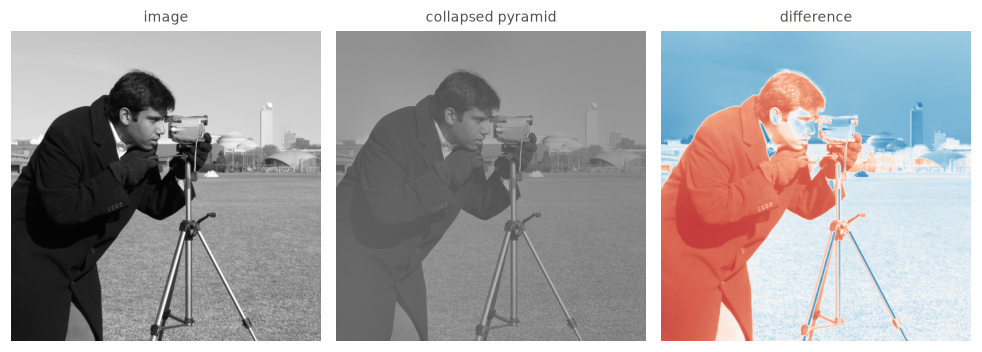
The collapsed pyramid is not the image. It has the right mean but a fraction of the contrast: dark regions come back too bright and bright regions too dark, so the difference image is a faded copy of the scene itself. The rms error is a fifth of the intensity range.
The forum thread tested the same promise at its smallest: one step of the
recurrence, , with
layer 0 from pyramid_laplacian and level 1 from pyramid_gaussian. That is a
valid test, because the identity must hold at every level for the full
collapse to work, and it fails there too.
l0_skimage = layers[0]
g = list(pyramid_gaussian(image, max_layer=1))
one_step = l0_skimage + pyramid_expand(g[1])
print(f"one step, forum experiment: rms(rebuilt - image) = {rms(one_step - image):.4f}")
one step, forum experiment: rms(rebuilt - image) = 0.0216
The one-step error is smaller than the full-collapse error, because only one layer is wrong in it. Section 5 says what the layers contain instead.
5. What pyramid_laplacian computes¶
The docstring says each layer is
resize(prev_layer) - smooth(resize(prev_layer)). In the notation above that is
: the Gaussian level minus a blurred
copy of itself, at the same resolution. The check below confirms this for
every layer.
layers = list(pyramid_laplacian(image))
g = list(pyramid_gaussian(image))

same_as_high_pass = [np.allclose(lk, gk - smooth(gk)) for lk, gk in zip(layers, g)]
print(f"{len(layers)} layers; each equals g_k - smooth(g_k): {all(same_as_high_pass)}")
print("shape of the last layer:", layers[-1].shape)
10 layers; each equals g_k - smooth(g_k): True
shape of the last layer: (1, 1)
Three things differ from the definition in section 3.
The comparison level is wrong. The layer subtracts , not . The two are equal only if downsampling then upsampling is the identity, and it is not.
There is no residual. The last layer is also a difference. The coarsest Gaussian level is never returned.
Every layer has zero mean. A Gaussian blur with reflecting boundaries preserves the sum of an image, so removes the mean at every level. The mean brightness of the input appears in no layer.
The last point has a one-line demonstration. A constant image produces a pyramid of zeros:
flat = np.full((64, 64), 0.7)
print("largest |value| over all layers of a constant image:",
      f"{max(np.abs(lk).max() for lk in pyramid_laplacian(flat)):.1e}")
largest |value| over all layers of a constant image: 2.2e-16
The first point is the forum author’s second guess: that the code assumes
smooth(image) equals expand(reduce(image)). Measured on the camera image:
b_g0 = smooth(image)
fg_g0 = pyramid_expand(pyramid_reduce(image))
print(f"rms(B g0 - F G g0) = {rms(b_g0 - fg_g0):.4f}   (rms of g0 itself: {rms(image):.4f})")
rms(B g0 - F G g0) = 0.0216 (rms of g0 itself: 0.5827)
Blurring, downsampling and upsampling blurs more than blurring alone. The layer-0 difference between the two constructions is that same array, because both subtract from the same .
6. The construction the definition asks for¶
laplacian_pyramid in section 2 follows section 3 with the scikit-image
operators: pyramid_gaussian for , and resize to the exact shape
of the finer level followed by the same blur for . collapse runs
the recurrence backwards. Reconstruction is exact to rounding.
layers_ok = laplacian_pyramid(image)
rebuilt_ok = collapse(layers_ok)

print(f"{len(layers_ok)} layers, last has shape {layers_ok[-1].shape}")
print(f"max |rebuilt - image| = {np.abs(rebuilt_ok - image).max():.1e}")
10 layers, last has shape (1, 1)
max |rebuilt - image| = 2.2e-16
For even shapes, expand_to is pyramid_expand; the check below shows the two
agree. The exact-shape form is needed for odd shapes, where pyramid_expand
returns one row or column too many. Section 9 comes back to this.
print("expand_to == pyramid_expand on a 256x256 level:",
      np.allclose(expand_to(g[1], g[0].shape), pyramid_expand(g[1])))

odd = np.random.default_rng(0).random((31, 27))
g_odd = list(pyramid_gaussian(odd))
print("odd input, Gaussian shapes:", [x.shape for x in g_odd])
print("pyramid_expand(g_1).shape:", pyramid_expand(g_odd[1]).shape, " g_0.shape:", g_odd[0].shape)
print(f"exact-shape reconstruction error: {np.abs(collapse(laplacian_pyramid(odd)) - odd).max():.1e}")
expand_to == pyramid_expand on a 256x256 level: True
odd input, Gaussian shapes: [(31, 27), (16, 14), (8, 7), (4, 4), (2, 2), (1, 1)]
pyramid_expand(g_1).shape: (32, 28) g_0.shape: (31, 27)
exact-shape reconstruction error: 0.0e+00
The book’s claim that the filters do not matter is also testable. Replace by nearest-neighbour upsampling followed by a fixed random 5-by-5 kernel. Reconstruction stays exact, as long as analysis and synthesis use the same kernel.
kernel = np.random.default_rng(1).random((5, 5))
kernel /= kernel.sum()


def random_expand(x, shape):
    """Nearest-neighbour upsampling followed by a fixed random blur."""
    up = resize(x, shape, order=0, mode="reflect", anti_aliasing=False)
    return ndi.convolve(up, kernel, mode="reflect")


layers_rand = laplacian_pyramid(image, expand=random_expand)
print(f"random F, same F in synthesis:      {np.abs(collapse(layers_rand, random_expand) - image).max():.1e}")
print(f"random F, default F in synthesis:   {np.abs(collapse(layers_rand, expand_to) - image).max():.3f}")
random F, same F in synthesis: 3.3e-16
random F, default F in synthesis: 0.272
7. The operators as matrices¶
The book writes each step as a matrix acting on a 1-D signal. The same can be done for the scikit-image operators, by feeding unit impulses through them. The signal length is 16.
n = 16
B = op_matrix(smooth, n, n)
G = op_matrix(pyramid_reduce, n, n // 2)
F = op_matrix(lambda e: expand_to(e, (n,)), n // 2, n)
I = np.eye(n)

np.set_printoptions(precision=3, suppress=True, linewidth=120)
print("row 8 of B          :", B[8])
print("row 4 of G = D B    :", G[4])
print("rows 7, 8 of F      :", F[7], F[8], sep="\n                      ")
row 8 of B : [0. 0. 0. 0. 0. 0. 0.007 0.194 0.598 0.194 0.007 0. 0. 0. 0. 0. ]
row 4 of G = D B : [0. 0. 0. 0. 0. 0. 0.003 0.1 0.396 0.396 0.1 0.003 0. 0. 0. 0. ]
rows 7, 8 of F :
[0. 0. 0.054 0.645 0.3 0.002 0. 0. ]
[0. 0. 0.002 0.3 0.645 0.054 0. 0. ]
Each row of averages two neighbouring input samples with equal
weight, because resize places the output sample between them.
interpolates linearly and then blurs. All three have unit row sums, so all
three preserve a constant signal.
The layer-0 operator of the current code is . The definition asks for . Their middle rows are the impulse responses of the two constructions.
L_current = I - B
L_correct = I - F @ G

fig, axes = plt.subplots(1, 2, figsize=(9, 3))
x = np.arange(n)
for ax, row, color, name in [
    (axes[0], L_current[8], C_ONE, "I − B  (pyramid_laplacian)"),
    (axes[1], L_correct[8], C_TWO, "I − F G  (Burt–Adelson)"),
]:
    ax.axhline(0, color=GRID, lw=0.8)
    ax.stem(x, row, linefmt=color, markerfmt="o", basefmt=" ")
    ax.set_xlim(2, 14)
    ax.set_ylim(-0.3, 1)
    ax.set_xlabel("sample")
    recede(ax, f"row 8 of {name}")
axes[0].set_ylabel("weight")
fig.tight_layout()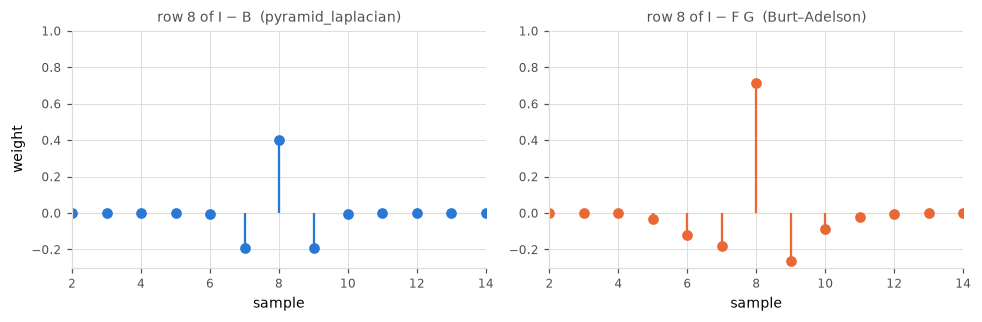
The current operator subtracts a narrow blur. The correct operator subtracts a wider one, and its negative lobe covers more samples. It is also not symmetric, because sample 8 sits off-centre between two samples of the coarse grid. Both rows sum to zero, so both remove the mean; the difference is the scale at which they do it.
Rank of the whole transform¶
Stack every layer’s operator into one analysis matrix, as the book does for in section 23.3. For the current pyramid, each block is applied after reductions, down to a single sample. For the correct pyramid, the blocks are after reductions, and the last block is the residual .
def stack_current(n):
    """Analysis matrix of pyramid_laplacian on a length-n signal."""
    rows, P, m = [], np.eye(n), n
    while True:
        Bm = op_matrix(smooth, m, m)
        rows.append((np.eye(m) - Bm) @ P)
        if m == 1:
            break
        m2 = math.ceil(m / 2)
        P = op_matrix(pyramid_reduce, m, m2) @ P
        m = m2
    return np.vstack(rows)


def stack_correct(n):
    """Analysis matrix of the Burt-Adelson pyramid on a length-n signal."""
    rows, P, m = [], np.eye(n), n
    while m > 1:
        m2 = math.ceil(m / 2)
        Gm = op_matrix(pyramid_reduce, m, m2)
        Fm = op_matrix(lambda e: expand_to(e, (m,)), m2, m)
        rows.append((np.eye(m) - Fm @ Gm) @ P)
        P = Gm @ P
        m = m2
    rows.append(P)
    return np.vstack(rows)


A_current = stack_current(n)
A_correct = stack_correct(n)
for name, A in [("pyramid_laplacian", A_current), ("Burt-Adelson", A_correct)]:
    print(f"{name:18s} analysis matrix {A.shape}, rank {np.linalg.matrix_rank(A)}")

_, s, vt = np.linalg.svd(A_current)
print("smallest singular value of the current matrix:", f"{s[-1]:.1e}")
print("its null vector:", vt[-1])
pyramid_laplacian analysis matrix (31, 16), rank 15
Burt-Adelson analysis matrix (31, 16), rank 16
smallest singular value of the current matrix: 7.6e-17
its null vector: [0.25 0.25 0.25 0.25 0.25 0.25 0.25 0.25 0.25 0.25 0.25 0.25 0.25 0.25 0.25 0.25]
Both matrices have 31 rows for 16 inputs, the overcompleteness the book describes. The correct one has full rank 16. The current one has rank 15, and its null space is spanned by the constant signal. So the current pyramid does contain the input up to its mean, in the linear-algebra sense: a least-squares solve recovers the mean-free signal. What it lacks is the mean, and a synthesis rule. No telescoping sum rebuilds the input, because the layers were not formed with any .
rng = np.random.default_rng(2)
sig = rng.random(n)
coeffs = A_current @ sig
lstsq, *_ = np.linalg.lstsq(A_current, coeffs, rcond=None)
print(f"least squares from current layers, error after removing the mean: "
      f"{np.abs((lstsq - lstsq.mean()) - (sig - sig.mean())).max():.1e}")
print(f"error of the mean itself: {abs(lstsq.mean() - sig.mean()):.3f}")
least squares from current layers, error after removing the mean: 1.0e-15
error of the mean itself: 0.428
8. Side by side¶
Layer 0 of both constructions on the camera image, with the row through the middle of the picture.
l0_ok = layers_ok[0]
row = image.shape[0] // 2

fig, axes = plt.subplots(2, 2, figsize=(9, 6.5), gridspec_kw={"height_ratios": [3, 1.3]})
lim = 0.15
bare(axes[0, 0], "layer 0, pyramid_laplacian").imshow(l0_skimage, cmap="RdBu_r", vmin=-lim, vmax=lim)
bare(axes[0, 1], "layer 0, Burt–Adelson").imshow(l0_ok, cmap="RdBu_r", vmin=-lim, vmax=lim)
for ax in axes[0]:
    ax.axhline(row, color=INK, lw=0.6)
axes[1, 0].plot(l0_skimage[row], color=C_ONE, lw=1, label="pyramid_laplacian")
axes[1, 1].plot(l0_ok[row], color=C_TWO, lw=1, label="Burt–Adelson")
for ax in axes[1]:
    ax.set_ylim(-0.3, 0.3)
    ax.set_xlim(0, image.shape[1])
    ax.legend(frameon=False, loc="upper right")
    recede(ax, f"row {row}")
fig.tight_layout()

print(f"rms layer 0: pyramid_laplacian {rms(l0_skimage):.4f}, Burt-Adelson {rms(l0_ok):.4f}")
rms layer 0: pyramid_laplacian 0.0227, Burt-Adelson 0.0411
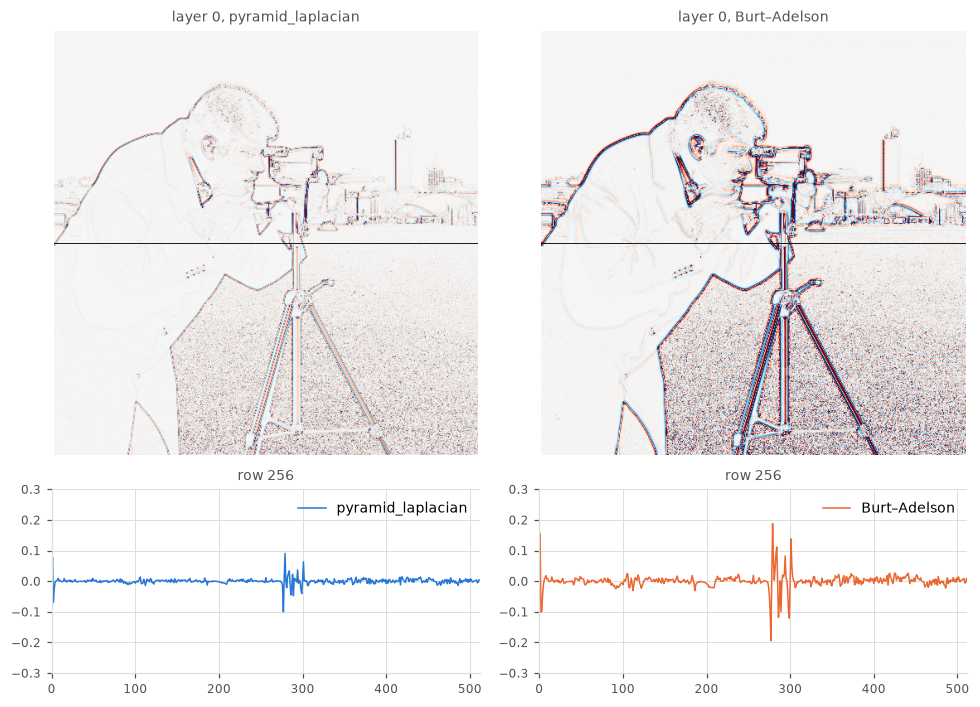
The correct layer has about 1.8 times the rms amplitude, because it holds everything between the input resolution and half of it. The current layer holds only what a blur removes.
9. How often, and how big¶
The corpus is every 2-D grey image in skimage.data that loads without a
network fetch, plus the first channel of the colour ones. Two quantities per
image: the reconstruction error of the current layers when the coarsest
Gaussian level is appended as a residual (the best a user can do with the
current output), and the reconstruction error of the corrected pyramid.
names = ["camera", "astronaut", "coins", "moon", "text", "page", "checkerboard",
         "horse", "brick", "grass", "gravel", "cell", "coffee", "chelsea",
         "rocket", "clock", "hubble_deep_field", "immunohistochemistry",
         "logo", "microaneurysms", "retina"]

records = []
for name in names:
    im = getattr(data, name)()
    if im.ndim == 3:
        im = im[..., 0]
    im = ski.util.img_as_float(im)

    cur = list(pyramid_laplacian(im))
    res = list(pyramid_gaussian(im))[-1]
    rebuilt_cur = collapse(cur[:-1] + [res])

    t0 = time.perf_counter()
    ok = laplacian_pyramid(im)
    t_ok = time.perf_counter() - t0
    t0 = time.perf_counter()
    list(pyramid_laplacian(im))
    t_cur = time.perf_counter() - t0

    records.append({
        "image": name, "shape": f"{im.shape[0]}x{im.shape[1]}",
        "rms current + residual": rms(rebuilt_cur - im),
        "max |err| corrected": np.abs(collapse(ok) - im).max(),
        "time ratio corrected / current": t_ok / t_cur,
    })

corpus = pd.DataFrame(records).set_index("image")
corpus.style.format({"rms current + residual": "{:.3f}",
                     "max |err| corrected": "{:.0e}",
"time ratio corrected / current": "{:.1f}"})print(f"{len(corpus)} images. Current + residual: rms error between "
f"{corpus['rms current + residual'].min():.3f} and {corpus['rms current + residual'].max():.3f} "
f"on a [0, 1] scale.")
print(f"Corrected: largest error {corpus['max |err| corrected'].max():.0e}.")
print(f"Corrected takes {corpus['time ratio corrected / current'].min():.1f}x to "
f"{corpus['time ratio corrected / current'].max():.1f}x the time.")21 images. Current + residual: rms error between 0.024 and 0.297 on a [0, 1] scale.
Corrected: largest error 7e-16.
Corrected takes 2.2x to 2.9x the time.
The failure is on every image, and its size is a large fraction of the intensity range. It is not a boundary or a precision effect.
10. Properties that ought to hold¶
Reconstruction. Sections 6 and 9: exact to rounding for the corrected pyramid, off by 0.02 to 0.3 rms for the current one.
The residual carries the mean. For the corrected pyramid, the mean of the residual equals the mean of the image to the accuracy of
resize; the mean of every other layer is close to zero. For the current pyramid, every layer has zero mean and nothing carries the image mean.Layer count. Both give
max_layer + 1images for the defaultmax_layer=-1. Section 12 measures the one case where they differ.
print(f"image mean {image.mean():.4f}; corrected residual mean {layers_ok[-1].mean():.4f}")
print("corrected, |mean| of layers 0..3:", [f"{abs(l.mean()):.1e}" for l in layers_ok[:4]])
print("current,   |mean| of layers 0..3:", [f"{abs(l.mean()):.1e}" for l in layers[:4]])
image mean 0.5061; corrected residual mean 0.5061
corrected, |mean| of layers 0..3: ['7.3e-07', '8.4e-07', '2.2e-05', '1.0e-04']
current, |mean| of layers 0..3: ['5.7e-17', '5.8e-17', '5.7e-17', '5.7e-17']
11. Comparators¶
The book’s matrix¶
Section 23.5 of the book prints for a length-8 signal with zero boundaries, the binomial filter , and . Building those matrices from the definitions reproduces the printed one entry for entry.
def binomial_matrix(n):
    """Blur by [1, 4, 6, 4, 1] / 16 with zero boundaries."""
    b = np.array([1, 4, 6, 4, 1]) / 16
    M = np.zeros((n, n))
    for i in range(n):
        for m in range(-2, 3):
            if 0 <= i + m < n:
                M[i, i + m] = b[m + 2]
    return M


n8 = 8
B0 = binomial_matrix(n8)
D0 = np.zeros((n8 // 2, n8))
D0[np.arange(n8 // 2), 2 * np.arange(n8 // 2)] = 1
U0 = D0.T
F0 = 2 * B0 @ U0
G0 = D0 @ B0

book = np.array([
    [182, -56, -24,  -8,  -2,   0,   0,   0],
    [-56, 192, -56, -32,  -8,   0,   0,   0],
    [-24, -56, 180, -56, -24,  -8,  -2,   0],
    [ -8, -32, -56, 192, -56, -32,  -8,   0],
    [ -2,  -8, -24, -56, 180, -56, -24,  -8],
    [  0,   0,  -8, -32, -56, 192, -56, -32],
    [  0,   0,  -2,  -8, -24, -56, 182, -48],
    [  0,   0,   0,   0,  -8, -32, -48, 224],
])
print("256 (I - F0 G0) equals the book's matrix:",
      np.array_equal(np.rint(256 * (np.eye(n8) - F0 @ G0)), book))
256 (I - F0 G0) equals the book's matrix: True
OpenCV¶
cv2.pyrDown and cv2.pyrUp implement Burt and Adelson’s REDUCE and
EXPAND with the binomial kernel. Building the pyramid with them and collapsing
it is exact to float32 rounding, with no scikit-image code involved.
def cv_pyramid(im, levels=5):
    """Laplacian pyramid from OpenCV's pyrDown and pyrUp."""
    g = [im]
    for _ in range(levels):
        g.append(cv2.pyrDown(g[-1]))
    out = [g[k] - cv2.pyrUp(g[k + 1], dstsize=g[k].shape[::-1]) for k in range(levels)]
    out.append(g[-1])
    return out


def cv_collapse(layers):
    """Rebuild the image from an OpenCV Laplacian pyramid."""
    out = layers[-1]
    for layer in layers[-2::-1]:
        out = layer + cv2.pyrUp(out, dstsize=layer.shape[::-1])
    return out


cv_layers = cv_pyramid(image.astype(np.float32))
print(f"OpenCV (float32) reconstruction, max |err| = {np.abs(cv_collapse(cv_layers) - image).max():.1e}")
OpenCV (float32) reconstruction, max |err| = 6.7e-08
12. The two pull requests¶
Two pull requests proposed the same change and both were closed by their authors after a maintainer asked whether they understood the algorithm. Neither was reviewed on technical grounds. The relevant question here is whether the code was right.
#8274 (August 2026, closes #8007): builds the Gaussian pyramid with
pyramid_gaussian, forms each layer asprev - expand(next)with a new private_pyramid_expand(image, out_shape, ...)thatpyramid_expandalso calls, and yields the last Gaussian level. Tests reconstruction for 1-D, 2-D and RGB inputs of odd size.#8306 (August 2026, closes #7921): the same construction with
resizeand_smoothinlined. Tests reconstruction on one 40-by-40 image.
The cell below is the loop shared by both, with the same argument handling.
def pyramid_laplacian_pr(image, max_layer=-1, downscale=2, sigma=None,
                         order=1, mode="reflect", cval=0, channel_axis=None):
    """The construction proposed in PRs 8274 and 8306."""
    image = ski.util.img_as_float(image)
    if sigma is None:
        sigma = 2 * downscale / 6.0
    g = pyramid_gaussian(image, max_layer=max_layer, downscale=downscale,
                         sigma=sigma, order=order, mode=mode, cval=cval,
                         preserve_range=True, channel_axis=channel_axis)
    prev = next(g)
    for layer in g:
        up = resize(layer, prev.shape, order=order, mode=mode, cval=cval,
                    anti_aliasing=False)
        yield prev - _smooth(up, sigma, mode, cval, channel_axis)
        prev = layer
    yield prev
Tests, in the order a reviewer would ask them.
rng = np.random.default_rng(3)
cases = {
    "1-D, 31": (rng.random(31), None),
    "2-D, 31x27": (rng.random((31, 27)), None),
    "RGB, 31x27x3": (rng.random((31, 27, 3)), -1),
    "camera 512x512": (image, None),
}
rows = []
for name, (im, cax) in cases.items():
    pr = list(pyramid_laplacian_pr(im, channel_axis=cax))
    out = pr[-1]
    for layer in pr[-2::-1]:
        up = resize(out, layer.shape, order=1, mode="reflect", anti_aliasing=False)
        out = layer + _smooth(up, SIGMA, "reflect", 0, cax)
    n_old = len(list(pyramid_laplacian(im, channel_axis=cax)))
    rows.append({"case": name, "layers PR": len(pr), "layers current": n_old,
                 "max |err| PR": np.abs(out - im).max()})
pd.DataFrame(rows).set_index("case").style.format({"max |err| PR": "{:.0e}"})print("PR construction equals laplacian_pyramid (section 2) on camera:",
all(np.allclose(a, b) for a, b in zip(pyramid_laplacian_pr(image), laplacian_pyramid(image))))PR construction equals laplacian_pyramid (section 2) on camera: True
The PR code is correct: exact reconstruction for odd sizes and for a channel
axis, and the same layer count as today for the default max_layer.
Two points remain.
An explicit max_layer past the natural end returns fewer layers.
pyramid_gaussian stops when a reduction no longer changes the shape.
The current pyramid_laplacian keeps yielding 1-by-1 zero layers until it
reaches max_layer. The PRs inherit the pyramid_gaussian behaviour. The
docstring promises max_layer + 1 images, so this is a documented-contract
change for one corner case. The automated review on #8306 raised it; neither PR
answered.
tiny = rng.random((4, 4))
print("4x4 input, max_layer=5:",
      f"current yields {len(list(pyramid_laplacian(tiny, max_layer=5)))} layers,",
      f"PR yields {len(list(pyramid_laplacian_pr(tiny, max_layer=5)))}.")
4x4 input, max_layer=5: current yields 6 layers, PR yields 3.
Users cannot collapse the pyramid with public functions. Both PRs, and
both of their tests, reach for resize plus the private _smooth, because
pyramid_expand(upscale=2) cannot produce an odd target shape (section 6). A
fix that makes the pyramid invertible should also give users a public inverse.
13. Ways forward¶
The construction is settled: it is the one in section 6, which both PRs implement. What remains is API.
Adopt the PR construction for
pyramid_laplacian, with the docstring rewritten around and the residual. #8274’s private_pyramid_expand(image, out_shape, ...)helper is the cleaner of the two, becausepyramid_expandthen shares it.Give
pyramid_expandan exact target. Either anout_shapekeyword or acceptance of a shape tuple forupscale, so that a user can write the synthesis loop with public functions. Without this, the reconstruction test in the PRs can only be written against private helpers.Add the inverse. A function that takes the list of layers and returns , and a test that round-trips odd, even, 1-D, and channel-axis inputs. Both closed PRs contain usable tests.
Decide the
max_layercorner case explicitly: either keep yielding 1-by-1 layers to honour the docstring, or change the docstring.In skimage2, change the default depth. The default
max_layer=-1reduces until a 1-by-1 residual, which is a near-mean scalar with no spatial content, and it inflates the layer count. A default that stops at a small but non-trivial residual (a minimum residual size, or a fixed number of octaves) gives a pyramid whose last element is a recognisable image, as in the book’s figures, and makes the reconstruction API simpler to explain: every element is an image, and the last one is the low-pass residual. The API goal for skimage2 is the cleanest, most intuitive round trip: decompose, edit layers, collapse, and get the input back to rounding.
14. What each fix costs¶
Every layer changes. All layers of all inputs differ from the current output. Any downstream code that used the current layers as a fixed-scale high-pass filter will see about twice the energy per layer (section 8).
Time. The corrected pyramid runs 1.5 to 3 times slower on the corpus in section 9, because it computes the Gaussian pyramid and one upsample-and-blur per level rather than one blur per level.
Layer count is unchanged except for an explicit
max_layerbeyond the natural end (section 12).
15. What not to do¶
Append the residual and keep the current layers. Section 9 measures this: the reconstruction error stays between 0.02 and 0.3 rms, because the layers were formed with rather than .
Collapse with pyramid_expand(upscale=2). It returns the wrong shape for
any odd level (section 6), and the addition fails. The forum thread’s first
code snippet fails this way on a colour image, where the channel axis is also
upsampled.
rgb = ski.util.img_as_float(data.astronaut())
g1_rgb = list(pyramid_gaussian(rgb, max_layer=1, channel_axis=-1))[1]
print("pyramid_expand on an RGB level without channel_axis:",
      pyramid_expand(g1_rgb).shape, "; with channel_axis=-1:",
      pyramid_expand(g1_rgb, channel_axis=-1).shape)
pyramid_expand on an RGB level without channel_axis: (512, 512, 6) ; with channel_axis=-1: (512, 512, 3)
Compare a float reconstruction with the integer input. The pyramid
functions convert to float in . The forum thread rescaled the
reconstruction back to with rescale_intensity, which stretches the
result to the observed extremes and so hides any offset. Compare in float.
16. Summary¶
| question | answer | cell |
|---|---|---|
What does pyramid_laplacian compute? | at each level, no residual | §5 |
| Does it rebuild the input? | No: rms error 0.02 to 0.3 on 21 images, even with a residual appended | §9 |
| What is lost? | The image mean, exactly; and the synthesis rule | §5, §7 |
| What does the definition ask for? | , last layer | §3, §6 |
| Does that rebuild the input? | Yes, to 10-16, for any used consistently | §6 |
| Are PRs #8274 and #8306 correct? | Yes; same construction, exact on odd, RGB, 1-D | §12 |
| What did they miss? | A public inverse; the max_layer corner case | §12 |
| Cost of the fix | All layers change; 1.5 to 3 times slower | §9, §14 |
Limits¶
Corpus: 21 images from
skimage.data, first channel of colour images,downscale=2, defaultsigma,order=1,mode='reflect'. Other downscale factors and boundary modes were not measured.The matrix analysis in section 7 is for a 1-D signal of length 16. The rank result was not checked for other lengths.
Versions: scikit-image printed in section 1; OpenCV, pandas and SciPy as installed.
The choice of affects how well each layer isolates one octave. This notebook tests only invertibility, not band separation.
References¶
P. J. Burt and E. H. Adelson, “The Laplacian Pyramid as a Compact Image Code,” IEEE Transactions on Communications, vol. COM-31, no. 4, pp. 532–540, April 1983. Burt & Adelson (1983). Author copy: http://
persci .mit .edu /pub _pdfs /pyramid83 .pdf. A. Torralba, P. Isola and W. T. Freeman, Foundations of Computer Vision, Adaptive Computation and Machine Learning series, The MIT Press, Cambridge, MA, 2024. ISBN 9780262378666. Chapter 23, “Image Pyramids”: https://
visionbook .mit .edu /pyramids _new _notation .html. E. Pascal et al., “Unclarity about Laplacian pyramid transform,” image.sc forum, 2025. https://
forum .image .sc /t /unclarity -about -laplacian -pyramid -transform /115976. scikit-image issues #7921 and #8007; pull requests #8274 and #8306.
Wikipedia, Pyramid (image processing) and Difference of Gaussians.
- Burt, P., & Adelson, E. (1983). The Laplacian Pyramid as a Compact Image Code. IEEE Transactions on Communications, 31(4), 532–540. 10.1109/tcom.1983.1095851