skimage.filters.frangi has five separable defects. Four are in the filter,
one is inherited from hessian_matrix and is fixed in on_hessian.md. This
notebook takes them one at a time: what the filter is supposed to do, what it
does, the smallest example that shows the difference, and a runnable repair.
| defect | consequence | state in this tree | |
|---|---|---|---|
| D1 | the wrong-sign rejection is defeated when | black_ridges has no effect on an ideal ridge | residue of #6436; repaired in frangi-fixes |
| D2 | no scale normalisation on the Hessian | ideal ridges never select their width; non-trivial vesselness collapses to the finest σ | #7711; repaired in frangi-fixes |
| D3 | gamma=None is resolved inside the σ loop | output depends on the order of sigmas | repaired in frangi-fixes |
| D4 | gamma=None exposes Frangi’s whole-image contrast heuristic without documenting its scope | one distant pixel changes the answer | the global heuristic is in Frangi; unchanged by the repairs, documented only |
| D5 | border error from the two-pass Hessian | a bright rim, large relative to the output range | on_hessian.md, fixes A and C |
| D6 | alpha is documented but inert in 2-D | a parameter that does nothing, silently | a docstring line |
Two code states appear through the notebook.
Pre-fix is
frangias released before thefrangi-fixesbranch: nosigma**2on the Hessian norm, a clipped divide in place of the sign test, andgamma=Noneresolved once, from the first scale.Post-fix is the branch:
sigma**2on the Hessian norm, an explicit sign test, andgamma=Noneresolved over every scale.
The notebook carries both implementations, as frangi_prefix and
frangi_postfix in §1, and uses them for every result. It does not call the
installed frangi for any measurement, so its answers do not depend on the
installed version. One cell in §1 reports which state the installation matches.
D3 and D4 are the subject of on_meijering.md’s sibling argument: both filters
let a whole-image number into the loop, but D3 is an order-dependent
implementation error while D4 exposes a published global contrast heuristic
without a locality contract.
D6 is a documentation defect and is dealt with in one paragraph.
Coordinates are in array order throughout. All sections assume 2-D unless they say otherwise.
import numpy as np
import pandas as pd
import matplotlib.pyplot as plt
from matplotlib.colors import LinearSegmentedColormap
from itertools import permutations

from nbhelper import show_table
import skimage as ski
from skimage.filters import frangi, sato, meijering
from skimage.feature import hessian_matrix, hessian_matrix_eigvals
import scipy.ndimage as ndifatal: not a git repository (or any of the parent directories): .git
fatal: not a git repository (or any of the parent directories): .git
# Slots 1 to 3 of the reference categorical palette, validated all-pairs;
# same palette as `on_meijering.md` and `on_hessian.md`.
C_ONE, C_TWO, C_THREE = "#2a78d6", "#eb6834", "#1baf7a"
INK, MUTED, GRID = "#0b0b0b", "#52514e", "#dedcd5"
SEQ = LinearSegmentedColormap.from_list("seq", ["#f7f7f4", C_ONE])

plt.rcParams.update(
    {"figure.dpi": 110, "font.size": 9, "axes.titlesize": 9,
     "axes.titlecolor": MUTED, "figure.facecolor": "white"}
)


def bare(ax, title=None):
    ax.set_xticks([]); ax.set_yticks([])
    for spine in ax.spines.values():
        spine.set_visible(False)
    if title:
        ax.set_title(title)
    return ax


def recede(ax, title=None):
    ax.tick_params(labelsize=8, colors=MUTED)
    for spine in ("top", "right"):
        ax.spines[spine].set_visible(False)
    for spine in ("left", "bottom"):
        ax.spines[spine].set_color(GRID)
    if title:
        ax.set_title(title)
    return ax
1. What frangi computes¶
Frangi’s filter asks, at every pixel and every scale, whether the local second order structure looks like a tube. It smooths the image with a Gaussian of width σ, takes the matrix of second derivatives — the Hessian — and looks at its eigenvalues , ordered so that .
This section uses the 2-D specialization of Frangi’s filter. For a bright line on a dark background the cross-section curves sharply downward and the along-line direction is flat, so and . For a blob both curve, so . In 3-D, the paper also uses the third eigenvalue and a plate-sensitivity ratio ; that factor is absent from the 2-D expression below. Frangi et al. (1998) turn the 2-D case into two dimensionless numbers and one absolute one:
and combine them as
with the convention that when the relevant eigenvalue has the wrong sign for the polarity being sought. In 2-D this is ; in 3-D the paper’s branch checks the relevant and signs. The final answer is the maximum of over a list of scales.
The paper calls the structuredness threshold , not . The
scikit-image API names its corresponding argument gamma; this notebook uses
for the paper’s quantity and reserves for Lindeberg’s derivative
normalization exponent.
Three things about that expression drive everything below.
is a ratio. Scaling the Hessian leaves it alone, so blobness carries no information about σ.
is the only absolute quantity, and is its reference level. is therefore the filter’s sole contrast threshold. Frangi sets it, in their words, to “half the value of the maximum Hessian norm”.
In 2-D the plate-sensitivity factor of the 3-D formula reduces to 1, so
alphanever enters (that is D6).
# Frangi's three quantities at each pixel, from the released Hessian.
def eigen_pair(image, sigma, mode="reflect", power=0.0):
    """Hessian eigenvalues, ordered by increasing magnitude, times sigma**power."""
    eigvals = hessian_matrix_eigvals(
        hessian_matrix(image, sigma, mode=mode, use_gaussian_derivatives=True))
    eigvals = np.take_along_axis(eigvals, abs(eigvals).argsort(0), 0)
    return eigvals * sigma**power


def prefix_parts(image, sigma, beta=0.5, **kwargs):
    """Blobness and S as the pre-fix `frangi` computes them, clip included."""
    eigvals = eigen_pair(image, sigma, **kwargs)
    lambda1 = eigvals[0]
    lambda2 = np.maximum(eigvals[1], 1e-10)          # the clip of the pre-fix code
    r_b = abs(lambda1) / lambda2
    return np.exp(-r_b**2 / (2 * beta**2)), np.sqrt((eigvals**2).sum(0))
1.1 The two code states¶
The notebook carries both implementations in full, so it does not depend on the
installed frangi. frangi_prefix is the released filter. frangi_postfix is
the same filter after the three repairs. Both handle 2-D and 3-D.
def frangi_prefix(image, sigmas, alpha=0.5, beta=0.5, gamma=None,
                  black_ridges=True, mode="reflect", cval=0):
    """`frangi` in the **pre-fix** state, before the `frangi-fixes` branch.

    No `sigma**2`, the clipped divide for the sign rejection, and `gamma=None`
    resolved once, from the first scale of the loop.  This reproduces the
    released filter.
    """
    image = np.asarray(image, dtype=float)
    sigmas = list(sigmas)
    if not black_ridges:
        image = -image
    filtered_max = np.zeros_like(image)
    for sigma in sigmas:
        eigvals = hessian_matrix_eigvals(hessian_matrix(
            image, sigma, mode=mode, cval=cval, use_gaussian_derivatives=True))
        eigvals = np.take_along_axis(eigvals, abs(eigvals).argsort(0), 0)
        lambda1 = eigvals[0]
        if image.ndim == 2:
            (lambda2,) = np.maximum(eigvals[1:], 1e-10)
            r_a = np.inf
            r_b = abs(lambda1) / lambda2
        else:  # ndim == 3
            lambda2, lambda3 = np.maximum(eigvals[1:], 1e-10)
            r_a = lambda2 / lambda3
            r_b = abs(lambda1) / np.sqrt(lambda2 * lambda3)
        s = np.sqrt((eigvals**2).sum(0))
        if gamma is None:
            gamma = s.max() / 2
            if gamma == 0:
                gamma = 1
        vals = 1.0 - np.exp(-(r_a**2) / (2 * alpha**2))
        vals *= np.exp(-(r_b**2) / (2 * beta**2))
        vals *= 1.0 - np.exp(-(s**2) / (2 * gamma**2))
        filtered_max = np.maximum(filtered_max, vals)
    return filtered_max
def frangi_postfix(image, sigmas, alpha=0.5, beta=0.5, gamma=None,
black_ridges=True, mode="reflect", cval=0):
"""`frangi` in the **post-fix** state, after the `frangi-fixes` branch.
`sigma**2` on the Hessian norm, an explicit sign test, and `gamma=None`
resolved over every scale.
"""
image = np.asarray(image, dtype=float)
sigmas = list(sigmas)
if not black_ridges:
image = -image
if gamma is None:
peaks = []
for sigma in sigmas:
eigvals = hessian_matrix_eigvals(hessian_matrix(
image, sigma, mode=mode, cval=cval,
use_gaussian_derivatives=True))
peaks.append((sigma**2 * np.sqrt((eigvals**2).sum(0))).max())
gamma = max(peaks) / 2 if peaks else 1.0
if gamma == 0:
gamma = 1
filtered_max = np.zeros_like(image)
for sigma in sigmas:
eigvals = hessian_matrix_eigvals(hessian_matrix(
image, sigma, mode=mode, cval=cval, use_gaussian_derivatives=True))
eigvals = np.take_along_axis(eigvals, abs(eigvals).argsort(0), 0)
lambda1 = eigvals[0]
wanted = np.all(eigvals[1:] > 0, axis=0)
shape = np.zeros_like(image)
if image.ndim == 2:
safe = np.where(wanted, eigvals[1], 1.0)
shape[wanted] = np.exp(-(lambda1[wanted] / safe[wanted])**2
/ (2 * beta**2))
else: # ndim == 3
safe2 = np.where(wanted, eigvals[1], 1.0)
safe3 = np.where(wanted, eigvals[2], 1.0)
plate = 1.0 - np.exp(-((safe2 / safe3)**2) / (2 * alpha**2))
blobness = np.exp(-(lambda1**2 / (safe2 * safe3)) / (2 * beta**2))
shape[wanted] = (plate * blobness)[wanted]
s = sigma**2 * np.sqrt((eigvals**2).sum(0))
filtered_max = np.maximum(
filtered_max, shape * (1.0 - np.exp(-(s**2) / (2 * gamma**2))))
return filtered_maxThe reference photograph and the σ list used throughout.
PHOTO = ski.util.img_as_float(ski.data.camera())[::2, ::2]
SIGMAS = (1, 3, 5, 7, 9)
N = 128
rows, cols = np.indices((N, N), dtype=float)
The installed version matches one state and not the other. The notebook uses the two implementations above for every later result, so the match below is informational only.
print(f"installed scikit-image {ski.__version__}")
installed = np.asarray(frangi(PHOTO, sigmas=SIGMAS), float)
for label, impl in (("pre-fix", frangi_prefix), ("post-fix", frangi_postfix)):
    gap = np.abs(np.asarray(impl(PHOTO, SIGMAS), float) - installed).max()
    print(f"   installed matches {label:<9}: max |difference| = {gap:.2e}")
installed scikit-image 0.26.1rc0.dev0
installed matches pre-fix : max |difference| = 0.00e+00
installed matches post-fix : max |difference| = 5.36e-01
2. D1 — black_ridges has no effect on an ideal ridge¶
Frangi’s rule is that a wrong-sign eigenvalue means “not a vessel”. In the paper this is an explicit zero branch in the 2-D and 3-D equations. The clipped-denominator mechanism below is the pre-fix implementation, not the paper’s derivation. If has the wrong sign, the intended response is zero; the implementation only gets that result when the other eigenvalue does not also clip to zero.
(lambda2,) = np.maximum(eigvals[1:], 1e-10)
r_b = abs(lambda1) / lambda2
The clip makes enormous — provided the numerator is not also zero. At the centre of a straight ridge the along-ridge curvature vanishes exactly, so , and , not . Blobness becomes : full marks, for a ridge of precisely the wrong polarity.
bright = np.exp(-((cols - 64) ** 2) / (2 * 3.0**2))      # a BRIGHT ridge
centre = (64, 64)

print("value at the ridge centre, pre-fix frangi;"
      " `black_ridges=True` asks for DARK ridges")
for polarity in (True, False):
    out = frangi_prefix(bright, sigmas=[3], black_ridges=polarity)
    print(f"   black_ridges={str(polarity):<6} {out[centre]:.6f}")
print(f"\nthe two outputs are identical everywhere:"
      f" {np.array_equal(frangi_prefix(bright, sigmas=[3]), frangi_prefix(bright, sigmas=[3], black_ridges=False))}")
value at the ridge centre, pre-fix frangi; `black_ridges=True` asks for DARK ridges
black_ridges=True 0.864665
black_ridges=False 0.864665
the two outputs are identical everywhere: True
The mechanism, read off the eigenvalues across the ridge.
lam = eigen_pair(bright, 3)
row = lam[:, 64, :]
blob, _ = prefix_parts(bright, 3)

# The shaded band is computed, not drawn by hand: it is exactly the set of
# columns whose larger-magnitude eigenvalue has the wrong sign.
wrong_band = row[1] < 0
columns = np.arange(N)

fig, axes = plt.subplots(1, 3, figsize=(11.5, 2.8))
axes[0].plot(bright[64], color=INK, lw=1.6)
recede(axes[0], "the input: a bright ridge")

axes[1].axhline(0, color=GRID, lw=1)
axes[1].plot(columns, row[0], color=C_ONE, lw=2.2, label=r"$\lambda_1$ (smaller $|\cdot|$)")
axes[1].plot(columns, row[1], color=C_TWO, lw=1.8, ls="--", label=r"$\lambda_2$ (larger $|\cdot|$)")
recede(axes[1], r"$\lambda_1$ is identically zero; $\lambda_2$ turns negative")
axes[1].legend(frameon=False, fontsize=8, loc="lower right")

axes[2].plot(columns, blob[64], color=C_THREE, lw=1.8)
recede(axes[2], "blobness, which should be 0 across the band")
axes[2].set_ylim(-0.05, 1.15)

for ax in axes[1:]:
    ax.fill_between(columns, *ax.get_ylim(), where=wrong_band,
                    color=C_TWO, alpha=0.12, lw=0)
axes[2].annotate(f"wrong sign for\n{wrong_band.sum()} columns", (64, 0.55),
                 ha="center", fontsize=8, color=MUTED)
for ax in axes:
    ax.set_xlabel("column", fontsize=8, color=MUTED)
fig.suptitle("D1: the rejection depends on a numerator that is exactly zero", y=1.05)
fig.tight_layout()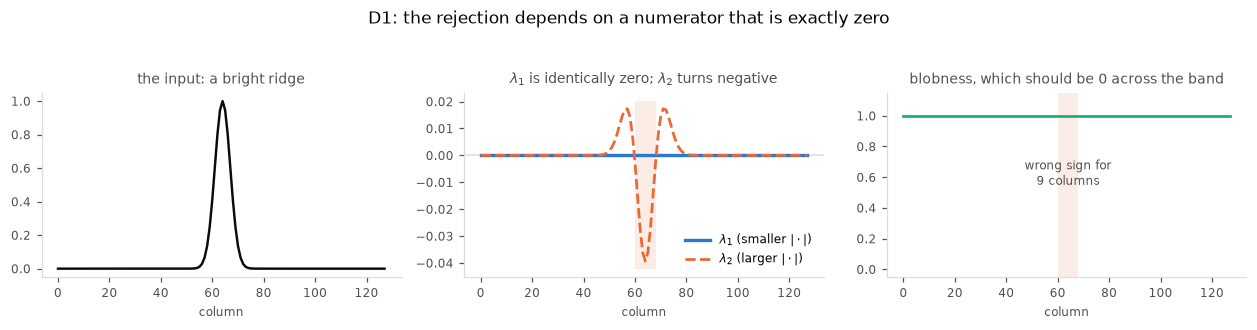
print(f"at the ridge centre:  lambda1 = {row[0][64]:.3e}   lambda2 = {row[1][64]:.3e}")
print(f"  clipped denominator = {max(row[1][64], 1e-10):.1e}")
print(f"  R_b = {abs(row[0][64]) / max(row[1][64], 1e-10):.4f}"
      f"   blobness = {blob[64, 64]:.4f}   (should be 0)")
at the ridge centre: lambda1 = 0.000e+00 lambda2 = -3.928e-02
clipped denominator = 1.0e-10
R_b = 0.0000 blobness = 1.0000 (should be 0)
2.1 How wide is the leak?¶
The rejection survives only while is large enough that is large. Solving for gives the threshold on below which blobness exceeds — that is, below which a wrong-polarity pixel is scored as a vessel.
BETA = 0.5

show_table(
    pd.DataFrame(
    [{"blobness above": theta,
      "needs |lambda1| below": f"{np.sqrt(-2 * BETA**2 * np.log(theta)) * 1e-10:.2e}"}
     for theta in (0.5, 0.01)]).set_index("blobness above")
)Those thresholds are minute, so the temptation is to say the leak cannot happen on real data. It has to be checked at every scale rather than one, because shrinks as σ grows.
def leak_census(image, sigmas, beta=BETA):
    """Wrong-sign pixels, and how many of them the clipped divide lets through."""
    out = []
    for sigma in sigmas:
        eigvals = eigen_pair(image, sigma)
        wrong = eigvals[1] < 0                 # wrong sign for black_ridges=True
        blobness, _ = prefix_parts(image, sigma)
        out.append({"sigma": sigma,
                    "wrong-sign pixels": f"{wrong.mean():.1%}",
                    "smallest |lambda1| there": f"{np.abs(eigvals[0][wrong]).min():.2e}",
                    "leak, blobness > 0.5": int((blobness[wrong] > 0.5).sum()),
                    "leak, blobness > 0.01": int((blobness[wrong] > 0.01).sum())})
    return pd.DataFrame(out).set_index("sigma")


show_table(leak_census(PHOTO, SIGMAS))print("straight synthetic ridges, |lambda1| at the centre:")
for width in (1.0, 3.0, 8.0):
ridge = np.exp(-((cols - 64) ** 2) / (2 * width**2))
print(f" width {width:>4}: {abs(eigen_pair(ridge, 3)[0][centre]):.2e}")straight synthetic ridges, |lambda1| at the centre:
width 1.0: 0.00e+00
width 3.0: 0.00e+00
width 8.0: 0.00e+00
So the leak is not quite absent from photographs. On camera it is silent at
σ = 1 through 7 and fires at σ = 9, where a single pixel is scored above 0.5 and
two above 0.01 out of 65536 — because there has fallen to
, below the threshold in the table. A σ = 3 scan alone would
have reported nothing and invited the stronger claim.
The honest summary is that D1 is vanishingly rare on photographs and universal
on clean ridges: every exactly straight ridge has along it, so
every one of them leaks completely. That is every construction anyone would
write a unit test or a documentation example around. skimage’s own
test_ridges.py does not catch it: its polarity tests compare
f(dark, black_ridges=True) against f(bright, black_ridges=False), a symmetry
that holds trivially because the implementation negates the image, and never
assert that a ridge of the wrong polarity scores zero.
2.2 The fix: test the sign, do not divide by it¶
Both ITK and the jerman filter proposed in
#8074 reject by an
explicit comparison rather than by arranging for a division to explode. ITK’s
HessianToObjectnessMeasureImageFilter is the clearest statement of it:
if ((m_BrightObject && sortedEigenValues[i] > 0.0) ||
    (!m_BrightObject && sortedEigenValues[i] < 0.0))
  { signConstraintsSatisfied = false; break; }
The same thing in NumPy, keeping the division away from the masked pixels:
def postfix_parts(image, sigma, beta=0.5, power=0.0, **kwargs):
    """Blobness and S with an explicit sign test instead of a clipped divide."""
    eigvals = eigen_pair(image, sigma, power=power, **kwargs)
    lambda1, lambda2 = eigvals[0], eigvals[1]
    right_sign = lambda2 > 0                    # dark ridge, after any negation
    r_b = np.abs(lambda1) / np.where(right_sign, lambda2, 1.0)
    blobness = np.where(right_sign, np.exp(-r_b**2 / (2 * beta**2)), 0.0)
    return blobness, np.sqrt((eigvals**2).sum(0))
def single_scale(parts_fn, image, sigma, gamma, black_ridges=True):
"""One scale of vesselness, given a `*_parts` function."""
blobness, norm = parts_fn(-image if not black_ridges else image, sigma)
return blobness * (1 - np.exp(-norm**2 / (2 * gamma**2)))
GAMMA_DEMO = np.sqrt((eigen_pair(bright, 3) ** 2).sum(0)).max() / 2
report = {}
for label, fn in (("pre-fix", prefix_parts), ("post-fix", postfix_parts)):
report[label] = {
"black_ridges=True": single_scale(fn, bright, 3, GAMMA_DEMO, True)[centre],
"black_ridges=False": single_scale(fn, bright, 3, GAMMA_DEMO, False)[centre],
}
show_table(pd.DataFrame(report).round(6))The right-polarity answer is untouched; the wrong-polarity answer goes from the
largest value the filter can produce to zero. That ceiling is worth naming: with
the structuredness gate at the most
curved pixel is , so a
single-scale frangi with the default γ cannot exceed that. A wrong-polarity
ridge was scoring exactly it.
3. D2 — no scale normalization for ideal ridges¶
frangi is documented as returning the “maximum of pixels across all scales”,
which allows different scales to win. On an ideal straight ridge, however, in
the pre-fix code falls with σ while blobness stays pegged at 1, so the
unnormalised structuredness term cannot select the ridge width. That is the
scale-normalisation problem reported by issue #7711. The paper itself says that
its maximum occurs at a scale approximately matching vessel size; the stronger
finest-scale result
below is for the ideal ridge model and this implementation. The argument also
needs care: is invariant under scaling the Hessian, not under changing
σ, which re-smooths the image and can move . Scale selection through
blobness is therefore possible in non-ideal structures.
3.0 Why falls on a Gaussian ridge¶
A unit-height Gaussian ridge of width , , smoothed by a Gaussian of width σ is again Gaussian, with variance and peak height :
The cross-ridge second derivative on the axis is therefore
which is strictly decreasing in σ for every . Along the ridge
, so and the same falloff holds
for Frangi’s Hessian norm. Multiplying by is exactly
Lindeberg’s normalisation of a second derivative — the same factor
on_meijering.md §5.1 derives — and is the reason any finite scale can win.
That is also what pegs blobness at 1: it makes , hence , at every scale rather than at the one scale §2 happened to sample. Both statements are checked below.
# A ridge is constant along its length, so a few rows are enough; reflecting a
# constant gives the same constant, so the row border cannot contaminate this.
STRIP = (24, 220)
strip_cols = np.indices(STRIP, dtype=float)[1]
SCAN = np.arange(1, 16.01, 0.5)
MIDDLE = (STRIP[0] // 2, 110)


def axis_profile(width, power=0.0):
    """S at the centre of a ridge of given width, across scales.

    Multiplying the Hessian by sigma**power multiplies both eigenvalues, and
    so S, by exactly that factor - so one scan serves every exponent.
    """
    ridge = -np.exp(-((strip_cols - MIDDLE[1]) ** 2) / (2 * width**2))
    base = np.array([np.sqrt((eigen_pair(ridge, s) ** 2).sum(0))[MIDDLE]
                     for s in SCAN])
    return base * SCAN**power


PROFILES = {w: axis_profile(w) for w in (2.0, 4.0, 6.0, 10.0)}


def falloff_law(width, exponent=-1.5):
    """The continuous prediction w (w^2 + sigma^2)^exponent, on the scan."""
    return width * (width**2 + SCAN**2) ** exponent


def worst_deviation(measured, predicted):
    """Largest relative gap between two curves, each normalised at sigma = 1."""
    a, b = measured / measured[0], predicted / predicted[0]
    return np.abs(a / b - 1).max()
Correlation is the wrong instrument here and it is worth saying why, because it looks like strong evidence. Two curves that both decay smoothly correlate at better than 0.99 whatever their exponents, so a high correlation cannot distinguish the predicted law from a wrong one. The largest relative deviation can.
CANDIDATES = {
    "w (w²+σ²)^(-3/2)   predicted": falloff_law(4.0, -1.5),
    "  (w²+σ²)^(-1)     wrong": (4.0**2 + SCAN**2) ** -1.0,
    "  (w²+σ²)^(-2)     wrong": (4.0**2 + SCAN**2) ** -2.0,
    "  exp(-σ/4)        wrong": np.exp(-SCAN / 4),
}
measured = PROFILES[4.0]
show_table(
    pd.DataFrame(
    [{"candidate law": name,
      "correlation": f"{np.corrcoef(measured / measured[0], law / law[0])[0, 1]:.6f}",
      "worst relative deviation": f"{worst_deviation(measured, law):.1%}"}
     for name, law in CANDIDATES.items()]).set_index("candidate law")
)Every candidate correlates above 0.99, the wrong ones included. The deviation column separates them: sub-1% for the predicted law against tens to hundreds of percent for the rest. So check the law on every width with that, and check the monotonicity claim on every width too rather than on one.
def along_ridge(width):
    """Largest |lambda1| and smallest blobness at the ridge centre, over SCAN."""
    ridge = -np.exp(-((strip_cols - MIDDLE[1]) ** 2) / (2 * width**2))
    worst_lambda1, least_blobness = 0.0, 1.0
    for sigma in SCAN:
        eigvals = eigen_pair(ridge, sigma)
        blobness, _ = prefix_parts(ridge, sigma)
        worst_lambda1 = max(worst_lambda1, abs(eigvals[0][MIDDLE]))
        least_blobness = min(least_blobness, blobness[MIDDLE])
    return worst_lambda1, least_blobness


rows_30 = []
for width, profile in PROFILES.items():
    worst_lambda1, least_blobness = along_ridge(width)
    rows_30.append({
        "ridge width w": width,
        "strictly decreasing in σ": bool(np.all(np.diff(profile) < 0)),
        "worst deviation from the law": f"{worst_deviation(profile, falloff_law(width)):.2%}",
        "largest |λ₁| over the scan": worst_lambda1,
        "smallest blobness over the scan": least_blobness,
    })
show_table(pd.DataFrame(rows_30).set_index("ridge width w"))falls monotonically at every width, tracks the continuous law to within a percent, and is zero — not small, zero — at every scale on the scan, so blobness never leaves 1. On an ideal ridge the only σ-dependence left really is , which is what makes the pre-fix filter’s maximum over scales collapse onto the finest one.
WIDTHS = (2.0, 4.0, 6.0)
fig, axes = plt.subplots(1, 3, figsize=(11.5, 3.0), sharex=True)
for ax, power, label in zip(
        axes, (0.0, 1.5, 2.0),
        (r"$S$  (pre-fix)", r"$\sigma^{1.5} S$  ($\gamma=3/4$)",
         r"$\sigma^{2} S$  ($\gamma=1$)")):
    for width, colour in zip(WIDTHS, (C_ONE, C_TWO, C_THREE)):
        curve = PROFILES[width] * SCAN**power
        curve = curve / curve.max()
        peak = SCAN[curve.argmax()]
        ax.plot(SCAN, curve, color=colour, lw=1.7, label=f"w = {width:g}, peak {peak:g}")
        ax.axvline(peak, color=colour, lw=0.8, ls=":", zorder=0)
    recede(ax, label)
    ax.set_xlabel("σ", fontsize=8, color=MUTED)
    ax.legend(frameon=False, fontsize=7.5, loc="upper right")
axes[0].set_ylabel("normalised response", fontsize=8, color=MUTED)
fig.suptitle("D2: without a σ power the peak is at the smallest σ for every width",
             y=1.04)
fig.tight_layout()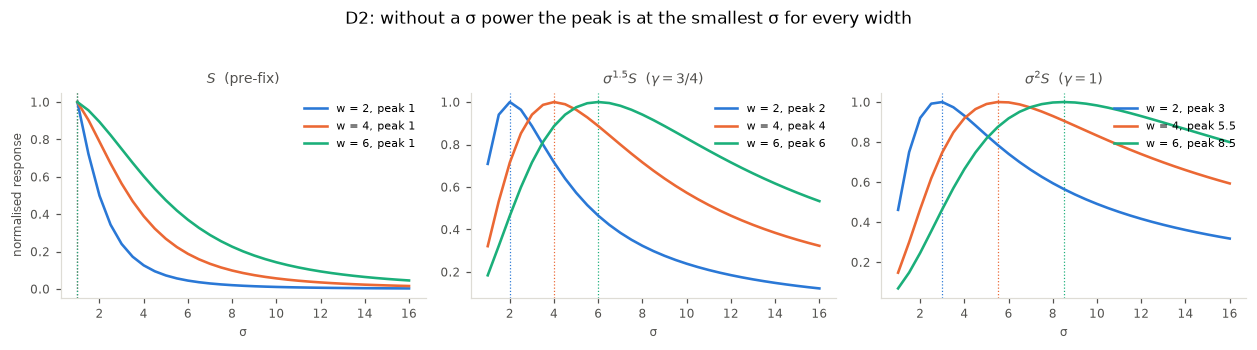
The left panel is the pre-fix filter: three ridges of quite different width, three curves that all peak at the smallest scale on the scan. The other two panels apply Lindeberg’s γ-normalisation, a factor on a second derivative. The peaks then land where the theory says.
selection = []
for width, base in PROFILES.items():
    row_out = {"true width w": width}
    for power, label in ((0.0, "S"), (1.5, "σ^1.5 S"), (2.0, "σ^2 S")):
        row_out[label] = SCAN[(base * SCAN**power).argmax()]
    row_out["predicted w"] = width
    row_out["predicted w·√2"] = round(width * np.sqrt(2), 2)
    selection.append(row_out)
show_table(pd.DataFrame(selection).set_index("true width w"))σ^1.5 selects the ridge’s own width and σ^2 selects — exactly the
two calibrations on_meijering.md §5 derives from Lindeberg (1998) §5.6.1,
now measured on Frangi’s rather than on Meijering’s eigenvalue. The choice
of exponent is the same open question in both filters.
On a photograph the same collapse shows up wherever vesselness is non-trivial.
Below a small floor the argmax over scales is noise among values near zero; above
it, without a σ power, the finest scale wins every time under the usual γ
(half the Hessian norm at sigmas[0]).
# Practical D2 on a photograph: who wins where vesselness is non-trivial?
# (Same arithmetic as frangi_cache/fuse below; inlined so this section runs alone.)
gamma_usual = np.sqrt((eigen_pair(PHOTO, SIGMAS[0]) ** 2).sum(0)).max() / 2
stack_d2 = []
for sigma in SIGMAS:
    blob, norm = prefix_parts(PHOTO, sigma)
    stack_d2.append(blob * (1 - np.exp(-norm**2 / (2 * gamma_usual**2))))
stack_d2 = np.stack(stack_d2)
vmax_d2 = stack_d2.max(0)
won_d2 = np.array(SIGMAS)[stack_d2.argmax(0)]
FLOOR_V = 0.01
live = vmax_d2 > FLOOR_V
print(f"camera, γ from sigmas[0]={SIGMAS[0]}: "
      f"{live.mean():.1%} of pixels have V > {FLOOR_V}")
print(f"  of those, won by σ={SIGMAS[0]}: {np.mean(won_d2[live] == SIGMAS[0]):.1%}")
print(f"  of those, won by any larger σ: "
      f"{np.mean(won_d2[live] > SIGMAS[0]):.1%}")
camera, γ from sigmas[0]=1: 10.1% of pixels have V > 0.01
of those, won by σ=1: 100.0%
of those, won by any larger σ: 0.0%
Two caveats keep this from being “every pixel, every γ”, and the second is worth measuring rather than conceding. First, among pixels with the argmax is meaningless, and a majority of the frame sits there. Second, if γ is driven small enough that the structuredness gate saturates at several scales, the gate stops discriminating and blobness decides instead — so a coarser scale can win. Shrinking γ below the default shows exactly that.
def winners_at_gamma(gamma, floor=FLOOR_V):
    """Share of the live set won by each sigma, at one gamma."""
    stack = np.stack([blob * (1 - np.exp(-norm**2 / (2 * gamma**2)))
                      for blob, norm in
                      (prefix_parts(PHOTO, sigma) for sigma in SIGMAS)])
    fused, won = stack.max(0), np.array(SIGMAS)[stack.argmax(0)]
    live_here = fused > floor
    return live_here.mean(), {s: np.mean(won[live_here] == s) for s in SIGMAS}


rows_gamma = []
for divisor in (1, 10, 100, 1000):
    share_live, shares = winners_at_gamma(gamma_usual / divisor)
    rows_gamma.append({"gamma": f"γ₀/{divisor}",
                       "live share of frame": f"{share_live:.1%}",
                       **{f"σ={s}": f"{v:.1%}" for s, v in shares.items()}})
show_table(pd.DataFrame(rows_gamma).set_index("gamma"))At the default γ the finest scale takes the whole live set. Divide γ by a thousand and the gate is saturated almost everywhere, blobness takes over, and σ = 9 wins a tenth of a much larger live set. So the defect is not that coarser scales are unreachable in floating point; it is that the filter never selects a ridge’s own width, and that non-trivial vesselness under the default γ collapses to the finest scale.
3.1 What the paper asks for¶
Frangi et al. define their derivatives in normalised form,
so a second derivative carries and the Hessian is scaled as a
whole. This is the derivative-normalization exponent, not
scikit-image’s gamma argument. The API argument corresponds to Frangi’s ,
the structuredness threshold. The pre-fix code applies no derivative factor at
all, which is — a boundary case for the ideal ridge model, where
no finite scale is selected. Issue
#7711 reports the
symptom directly: “Due to the missing scale corrections only the smallest scale
affects the filter output.”
The repair is one multiplication, and it belongs on the Hessian so that both and see a consistently scaled matrix.
The same statement holds for the whole vesselness rather than on alone. The
structuredness threshold has to be chosen so the gate does not saturate:
once it reaches 1 at
several scales the maximum is a tie, and max then returns whichever came
first, which says nothing about scale selection.
SIGMA_GRID = (1, 2, 3, 4, 6, 8, 10, 12)
ridge6 = np.exp(-((strip_cols - MIDDLE[1]) ** 2) / (2 * 6.0**2))

rows_out = []
for power in (0.0, 1.5, 2.0):
    parts = {s: postfix_parts(-ridge6, s, power=power) for s in SIGMA_GRID}
    # Docstring rule: gamma = half the largest Hessian norm over the scan.
    gamma = max(norm.max() for _, norm in parts.values()) / 2
    scores = {s: (b * (1 - np.exp(-n**2 / (2 * gamma**2))))[MIDDLE]
              for s, (b, n) in parts.items()}
    rows_out.append({"factor": f"sigma**{power}",
                     "winning sigma": max(scores, key=scores.get),
                     "scales within 1e-6 of the winner":
                         sum(v > max(scores.values()) - 1e-6 for v in scores.values())})
show_table(pd.DataFrame(rows_out).set_index("factor"))The width-6 ridge is won by σ = 1 with no exponent, by σ = 6 with , and by σ = 8 with — the same three answers as the table above, now with the blobness factor and the gate included, and with the tie count confirming the winner is unique.
4. D3 — the answer depends on the order of sigmas¶
In the pre-fix code, gamma=None is resolved with the assignment inside the
scale loop:
for sigma in sigmas:                       # <- the loop
    ...
    s = np.sqrt((eigvals**2).sum(0))       # the Hessian norm
    if gamma is None:
        gamma = s.max() / 2                # rebinds the local name
        if gamma == 0:
            gamma = 1
    ...
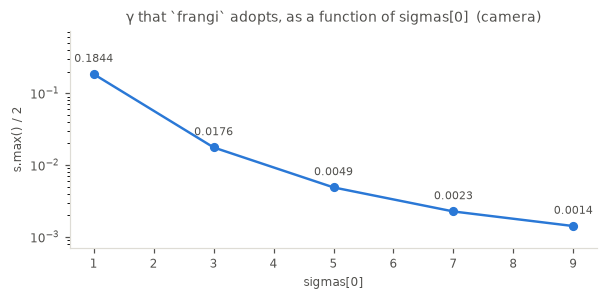
On the first iteration the test is true and gamma becomes a number. On every
later iteration it is false. So γ is half the largest Hessian norm at
sigmas[0], and since §3 established that falls with σ, the number
depends strongly on which scale happens to be written first.
gammas = {s: np.sqrt((eigen_pair(PHOTO, s) ** 2).sum(0)).max() / 2 for s in SIGMAS}

fig, ax = plt.subplots(figsize=(5.6, 2.8))
ax.plot(list(gammas), list(gammas.values()), "o-", color=C_ONE, lw=1.6, ms=5)
ax.set_yscale("log")
ax.set_ylim(min(gammas.values()) / 2, max(gammas.values()) * 4)
recede(ax, "γ that `frangi` adopts, as a function of sigmas[0]  (camera)")
ax.set_xlabel("sigmas[0]", fontsize=8, color=MUTED)
ax.set_ylabel("s.max() / 2", fontsize=8, color=MUTED)
for s, g in gammas.items():
    ax.annotate(f"{g:.4f}", (s, g), textcoords="offset points", xytext=(0, 8),
                ha="center", fontsize=7, color=MUTED)
fig.tight_layout()
print(f"γ spans a factor of {max(gammas.values()) / min(gammas.values()):.0f}"
      f" across sigmas = {SIGMAS}")
γ spans a factor of 130 across sigmas = (1, 3, 5, 7, 9)
Three ridges of different width, the same three scales, written twice.
CENTRES, WIDTHS_DEMO = (20, 48, 76), (1.2, 3.0, 6.0)
three = sum(np.exp(-((cols - c) ** 2) / (2 * w**2))
            for c, w in zip(CENTRES, WIDTHS_DEMO))
TRIPLE = (1, 3, 6)
up = frangi_prefix(three, sigmas=TRIPLE, black_ridges=False)
down = frangi_prefix(three, sigmas=TRIPLE[::-1], black_ridges=False)

fig, axes = plt.subplots(1, 4, figsize=(11.5, 2.5),
                         gridspec_kw={"width_ratios": [1, 1, 1, 1.5]})
bare(axes[0], f"input: widths {WIDTHS_DEMO}")
axes[0].imshow(three, cmap=SEQ)
for ax, out, label in ((axes[1], up, f"sigmas={TRIPLE}"),
                       (axes[2], down, f"sigmas={TRIPLE[::-1]}")):
    bare(ax, label)
    ax.imshow(out, cmap=SEQ, vmin=0, vmax=1)
axes[3].plot(up[N // 2], color=C_ONE, lw=1.6, label="ascending")
axes[3].plot(down[N // 2], color=C_TWO, lw=1.6, ls="--", label="descending")
recede(axes[3], "response across the middle row")
axes[3].set_xlabel("column", fontsize=8, color=MUTED)
axes[3].set_ylim(-0.05, 1.45)
axes[3].set_yticks([0, 0.5, 1.0])
axes[3].legend(frameon=False, fontsize=8, loc="upper center", ncol=2)
fig.suptitle("D3: same image, same three scales, different tuple order", y=1.04)
fig.tight_layout()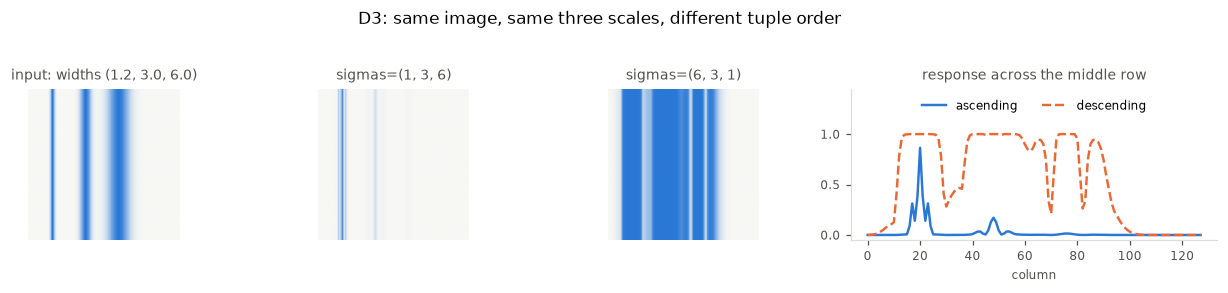
mid = N // 2
show_table(
    pd.DataFrame(
    {"true width": WIDTHS_DEMO,
     f"sigmas={TRIPLE}": [up[mid, c] for c in CENTRES],
     f"sigmas={TRIPLE[::-1]}": [down[mid, c] for c in CENTRES]},
    index=pd.Index(CENTRES, name="ridge at column"),
    ).round(4)
)Ascending, the filter reports one vessel: the narrow ridge scores 0.86 and the widest 0.015, which reads as “not a vessel”. Descending, all three saturate at 1.0 — and so, as the profile shows, does most of the background between them. These are two different answers to which of these is a vessel, and the second barely discriminates at all.
If the mechanism above is right, two orderings agree exactly when they share a first element: six permutations, three predicted classes.
orbit = {}
for perm in permutations(SIGMAS[:3]):
    orbit.setdefault(round(float(frangi_prefix(PHOTO, sigmas=perm).sum()), 6), []).append(perm)

print(f"{len(orbit)} distinct outputs from 6 permutations;"
      f" total response spans a factor of {max(orbit) / min(orbit):.0f}")
show_table(
    pd.DataFrame([{"sum of output": k,
               "first sigma": sorted({p[0] for p in v}),
               "permutations": ", ".join(map(str, v))}
              for k, v in sorted(orbit.items())]).set_index("sum of output")
)
3 distinct outputs from 6 permutations; total response spans a factor of 28
4.1 The promise this breaks¶
Two documented contracts, both in frangi’s own docstring. The return value is
out: Filtered image (maximum of pixels across all scales).
A maximum over a collection does not depend on the order of the collection, and
sigmas is documented as “Sigmas used as scales of filter” with no hint that
order matters. And the default γ is
The default, None, uses half of the maximum Hessian norm.
Half of the maximum Hessian norm, not half of the maximum at one arbitrary
member of sigmas. Read literally, the docstring already describes the fix.
over_all = max(gammas.values())
print(f"'half of the maximum Hessian norm' over sigmas={SIGMAS}: {over_all:.6f}")
print("what frangi actually uses, per first sigma:")
for s, g in gammas.items():
    print(f"   sigmas[0] = {s}: {g:.6f}"
          f"{'   <- matches the docstring' if g == over_all else ''}")
'half of the maximum Hessian norm' over sigmas=(1, 3, 5, 7, 9): 0.184388
what frangi actually uses, per first sigma:
sigmas[0] = 1: 0.184388 <- matches the docstring
sigmas[0] = 3: 0.017605
sigmas[0] = 5: 0.004892
sigmas[0] = 7: 0.002263
sigmas[0] = 9: 0.001418
4.2 The fix: resolve γ before the loop¶
Vesselness splits cleanly at γ, so the scale loop can compute everything else first — at one Hessian per σ, the same number the pre-fix loop performs.
def frangi_cache(image, sigmas, parts_fn=postfix_parts, power=0.0,
                 black_ridges=True, mode="reflect"):
    """`parts_fn` at every scale, computed once."""
    image = image.astype(float, copy=False)
    if not black_ridges:
        image = -image
    return [parts_fn(image, sigma, power=power, mode=mode) for sigma in sigmas]


def fuse(cached, gamma):
    """Maximum over scales. `gamma` is a number, or "per-scale"."""
    stack = []
    for blobness, norm in cached:
        g = (norm.max() / 2 or 1.0) if gamma == "per-scale" else gamma
        stack.append(blobness * (1 - np.exp(-norm**2 / (2 * g**2))))
    return np.stack(stack)


def resolved_gamma(cached):
    """Half the largest Hessian norm over every scale, as the docstring says."""
    return max(norm.max() for _, norm in cached) / 2 or 1.0
def hoisted(image, sigmas, **kwargs):
cached = frangi_cache(image, sigmas, parts_fn=prefix_parts, **kwargs)
return fuse(cached, resolved_gamma(cached)).max(0)
TRIO = SIGMAS[:3]
base = hoisted(PHOTO, TRIO)
worst_fixed = max(np.abs(hoisted(PHOTO, p) - base).max() for p in permutations(TRIO))
prefix_base = frangi_prefix(PHOTO, sigmas=TRIO)
worst_prefix = max(np.abs(frangi_prefix(PHOTO, sigmas=p) - prefix_base).max()
for p in permutations(TRIO))
print(f"worst max|difference| over all six permutations of {TRIO}")
print(f" pre-fix {worst_prefix:.4f}")
print(f" hoisted {worst_fixed:.4f}")
print(f"\nhoisted vs pre-fix on the ascending list:"
f" {np.abs(hoisted(PHOTO, SIGMAS) - frangi_prefix(PHOTO, sigmas=SIGMAS)).max():.3g}")worst max|difference| over all six permutations of (1, 3, 5)
pre-fix 0.9942
hoisted 0.0000
hoisted vs pre-fix on the ascending list: 0
On an ascending list the hoisted version reproduces the pre-fix output exactly,
because §3 showed falls with σ, so the maximum over all scales is attained
at min(sigmas), which for a sorted list is also sigmas[0]. That ceases to
be true once D2 is fixed, and §10 returns to the consequence.
5. D4 — γ = None is a whole-image statistic¶
Fixing the order (§4) does not make the filter local. In the post-fix code,
gamma=None is a maximum over every scale, and in the pre-fix code it is a
maximum over the first scale; either way it is a maximum over every pixel, so a
single bright speck anywhere in the frame sets the contrast reference for the
whole image. Frangi explicitly describes as depending on the image
grey-scale range and recommends half the maximum Hessian norm. The global
statistic is therefore part of the published heuristic; the issue here is that
the API exposes it as gamma=None without documenting the non-local effect.
on_meijering.md §1 uses the same two probes.
def far_field(fn, image, spot=(0, 0), value=10.0, keep=100):
    """Relative change 100 px away when one distant pixel is brightened."""
    edited = image.copy()
    edited[spot] = value
    before, after = fn(image), fn(edited)
    far = (slice(keep, None), slice(keep, None))
    return (np.abs(before[far] - after[far]).max()
            / max(np.abs(before[far]).max(), 1e-12))


# `truncate` defaults to 4, so the sigma=9 kernel reaches 36 px. The margin has
# to exceed that, or the probe measures the border defect (D5) instead.
def crop_change(fn, image, size=140, margin=40):
    """Change in the shared interior when the surroundings are cropped away."""
    whole, part = fn(image)[:size, :size], fn(image[:size, :size])
    inner = (slice(margin, -margin),) * 2
    return (np.abs(whole[inner] - part[inner]).max()
            / max(np.abs(whole[inner]).max(), 1e-12))


probes = {}
for label, fn in (
        ("meijering", lambda im: meijering(im, sigmas=SIGMAS)),
        ("sato", lambda im: sato(im, sigmas=SIGMAS, mode="reflect")),
        ("frangi post-fix, gamma=None", lambda im: frangi_postfix(im, sigmas=SIGMAS)),
        ("frangi post-fix, gamma=15",
         lambda im: frangi_postfix(im, sigmas=SIGMAS, gamma=15))):
    probes[label] = {"one distant pixel": far_field(fn, PHOTO),
                     "crop the surroundings": crop_change(fn, PHOTO)}
show_table(pd.DataFrame(probes).T.map(lambda v: f"{v:.2%}"))sato is local under both probes, as a filter should be. The post-fix frangi
is not, and stops being non-local the moment γ is given explicitly — which
identifies γ as the sole cause. D4 is not one of the three repairs: the post-fix
default is a maximum over every scale, which is still a whole-image statistic.
Two cautions about reading that table. The margin matters: if it is smaller
than the widest kernel support, the crop probe measures the border defect of §6
rather than non-locality. And the crop probe can read 0.00% for frangi even
at gamma=None — that is not evidence of locality, only evidence that this
crop happened to keep the pixel that sets the maximum. A probe returning zero
proves nothing on its own; the far-field column is the one doing the work here.
# The σ=9 kernel at truncate=4 reaches 36 px; margin=20 sits inside that support.
for margin in (20, 40):
    print(f"sato crop_change at margin={margin}: "
          f"{crop_change(lambda im: sato(im, sigmas=SIGMAS, mode='reflect'), PHOTO, margin=margin):.2%}")
sato crop_change at margin=20: 4.41%
sato crop_change at margin=40: 0.00%
There is no repair that keeps gamma=None and restores locality, because the
default is defined as an image-wide statistic. The honest options are to
document it, or to give γ a local meaning, and only the first is a bug fix.
on_meijering.md faces the same wall for the same reason.
5.1 How much does γ disturb the comparison between scales?¶
It is tempting to say a single frozen γ rescales every scale alike and so leaves the cross-scale comparison intact, unlike a per-scale divisor. That is the wrong reason for the right distinction. The structuredness gate is not linear in , and different scales arrive with different , so changing γ reweights the scales against each other even when one γ is used for all of them.
def winning_sigma_map(image, sigmas, gamma, **kwargs):
    """Which sigma gives the largest vesselness at each pixel."""
    cached = frangi_cache(image, sigmas, parts_fn=prefix_parts, **kwargs)
    return np.array(sigmas)[fuse(cached, gamma).argmax(0)]


cached_photo = frangi_cache(PHOTO, SIGMAS, parts_fn=prefix_parts)
maps = {f"γ from sigma={s}": np.array(SIGMAS)[fuse(cached_photo, gammas[s]).argmax(0)]
        for s in (SIGMAS[0], SIGMAS[-1])}
maps["γ per scale"] = np.array(SIGMAS)[fuse(cached_photo, "per-scale").argmax(0)]
# Vesselness under the usual γ; used to ignore near-zero argmax noise below.
V_REF = fuse(cached_photo, gammas[SIGMAS[0]]).max(0)
V_FLOOR = 0.01

show_table(
    pd.DataFrame({label: {s: f"{np.mean(won == s):.1%}" for s in SIGMAS}
              for label, won in maps.items()}).T
)low, high = maps[f"γ from sigma={SIGMAS[0]}"], maps[f"γ from sigma={SIGMAS[-1]}"]
live = V_REF > V_FLOOR
print("fraction of pixels where the winning sigma changes")
print(f" all pixels, frozen γ (sigmas[0]=1 vs 9) : {np.mean(low != high):.1%}")
print(f" all pixels, frozen γ vs γ per scale : "
f"{np.mean(maps['γ per scale'] != low):.1%}")
print(f" among V > {V_FLOOR}, frozen γ reorder : {np.mean(low[live] != high[live]):.1%}"
f" ({live.mean():.1%} of the image)")
print(f" among V > {V_FLOOR}, vs γ per scale : "
f"{np.mean(maps['γ per scale'][live] != low[live]):.1%}")fraction of pixels where the winning sigma changes
all pixels, frozen γ (sigmas[0]=1 vs 9) : 5.7%
all pixels, frozen γ vs γ per scale : 43.0%
among V > 0.01, frozen γ reorder : 18.1% (10.1% of the image)
among V > 0.01, vs γ per scale : 44.6%
The distinction is quantitative, not categorical. All-pixel argmax counts are
diluted by the near-zero background, where the winning scale is noise among
values close to zero; restricting to , about a tenth of the frame
under the usual γ, is the comparison that bears on vessel selection. On that
set, reordering sigmas moves the winning scale at 18% of the pixels with
, and a per-scale γ moves it at 45% of the same set — against
6% and 43% when the background is allowed to dilute both. A frozen γ is the
milder of the two, not an innocent one, and restricting to the live set makes
the reordering defect three times larger, not smaller.
6. D5 — the border rim¶
The last defect is not frangi’s own. hessian_matrix filters each axis in
turn with a Gaussian and then differentiates, so the boundary extension is
applied to an already-smoothed array rather than to the image; on_hessian.md
diagnoses it and gives fixes A and C. The consequence in frangi is a bright
rim.
A reference that must agree: extend the image symmetrically, filter, and crop
back. With mode='reflect' an exact implementation gives the same answer on the
shared pixels.
def taps(sigma, order, trunc=8):
    """The 1-D kernel `gaussian_filter` builds, from the explicit formula."""
    lw = int(trunc * sigma + 0.5)
    x = np.arange(-lw, lw + 1).astype(float)
    g = np.exp(-(x**2) / (2 * sigma**2))
    g /= g.sum()
    if order == 0:
        return x, g
    if order == 1:
        return x, g * (x / sigma**2)
    return x, g * ((x**2 - sigma**2) / sigma**4)


def corrected_taps(sigma, order):
    """Fix C of `on_hessian.md`: repair the discrete moments."""
    x, g = taps(sigma, 0)
    _, k = taps(sigma, order)
    if order == 0:
        return x, g
    if order == 1:
        return x, k / (k * x).sum()             # exact on f = x
    k = k - k.sum() * g                         # annihilate constants
    return x, k / ((k * x**2).sum() / 2)        # exact on f = x**2 / 2


def repaired_eigen_pair(image, sigma, mode="reflect", power=0.0):
    """Fix A (one pass per element) + fix C, then the 2x2 eigenvalues."""
    def element(orders):
        out = image
        for axis, order in enumerate(orders):
            out = ndi.correlate1d(out, corrected_taps(sigma, order)[1],
                                  axis=axis, mode=mode)
        return out

    hrr, hrc, hcc = (element(o) for o in ((2, 0), (1, 1), (0, 2)))
    total = hrr + hcc
    spread = np.sqrt((hrr - hcc) ** 2 + 4 * hrc**2)
    eigvals = np.stack([(total + spread) / 2, (total - spread) / 2]) * sigma**power
    return np.take_along_axis(eigvals, abs(eigvals).argsort(0), 0)
def vesselness(image, sigmas, gamma, eig_fn, beta=0.5, mode="reflect"):
"""Whole filter, parameterised by the eigenvalue routine."""
out = np.zeros_like(image, dtype=float)
for sigma in sigmas:
eigvals = eig_fn(image, sigma, mode=mode)
lambda1, lambda2 = eigvals[0], eigvals[1]
ok = lambda2 > 0
r_b = np.abs(lambda1) / np.where(ok, lambda2, 1.0)
blobness = np.where(ok, np.exp(-r_b**2 / (2 * beta**2)), 0.0)
norm = np.sqrt((eigvals**2).sum(0))
out = np.maximum(out, blobness * (1 - np.exp(-norm**2 / (2 * gamma**2))))
return out
# A crop, so the padded copy stays small: the rim is what is under test.
ZOOM = 16
CROP = PHOTO[:128, :128]
PAD, GAMMA_FIXED, BORDER_SIGMAS = 40, 0.05, (1, 3, 5)
extended = np.pad(CROP, PAD, mode="symmetric") # matches mode='reflect'
border = {}
for label, eig_fn in (("released Hessian", eigen_pair),
("Hessian fixes A + C", repaired_eigen_pair)):
here = vesselness(CROP, BORDER_SIGMAS, GAMMA_FIXED, eig_fn)
there = vesselness(extended, BORDER_SIGMAS, GAMMA_FIXED, eig_fn)[PAD:-PAD, PAD:-PAD]
delta = np.abs(here - there) / here.max()
border[label] = {f"beyond {k} px": delta[k:-k, k:-k].max() if k else delta.max()
for k in (0, 1, 3, 10)}
border[label]["_map"] = delta
frames = {k: {kk: vv for kk, vv in v.items() if kk != "_map"} for k, v in border.items()}
for label, v in border.items():
print(f"{label:<22} largest disagreement anywhere: {v['_map'].max():.3g}")
show_table(pd.DataFrame(frames).T.map(lambda v: f"{v:.2%}"))released Hessian largest disagreement anywhere: 0.769
Hessian fixes A + C largest disagreement anywhere: 0
# The rim is one or two pixels wide and the error spans nine decades, so a
# linear colour scale shows nothing. Use a log norm, and let the code find
# where the worst pixel actually is rather than guessing a corner.
from matplotlib.colors import LogNorm

FLOOR = 1e-7
released_map = border["released Hessian"]["_map"]
hot = tuple(int(v) for v in np.unravel_index(released_map.argmax(), released_map.shape))

fig, axes = plt.subplots(1, 2, figsize=(10.6, 3.4),
                         gridspec_kw={"width_ratios": [1, 1.25], "wspace": 0.45})
im = axes[0].imshow(np.maximum(released_map, FLOOR), cmap=SEQ,
                    norm=LogNorm(vmin=FLOOR, vmax=released_map.max()))
axes[0].plot(hot[1], hot[0], "o", mfc="none", mec=C_TWO, ms=11, mew=1.5)
bare(axes[0], f"released Hessian; worst pixel row {hot[0]}, col {hot[1]}"
              f" at {released_map.max():.0%}")
fig.colorbar(im, ax=axes[0], fraction=0.046, pad=0.04)

for (label, v), colour in zip(border.items(), (C_ONE, C_THREE)):
    # Worst disagreement among all pixels exactly k from the nearest edge.
    r, c = np.indices(v["_map"].shape)
    height, width = v["_map"].shape
    depth = np.minimum.reduce([r, c, height - 1 - r, width - 1 - c])
    profile = [v["_map"][depth == k].max() for k in range(ZOOM)]
    axes[1].semilogy(range(ZOOM), np.maximum(profile, 1e-17), "o-",
                     color=colour, lw=1.6, ms=4, label=label)
recede(axes[1], "worst disagreement at each depth from the edge")
axes[1].set_xlabel("pixels from the nearest edge", fontsize=8, color=MUTED)
axes[1].set_ylabel("fraction of output range", fontsize=8, color=MUTED)
axes[1].legend(frameon=False, fontsize=8)
fig.suptitle("D5: the disagreement is a rim, and fixes A + C remove it", y=1.03)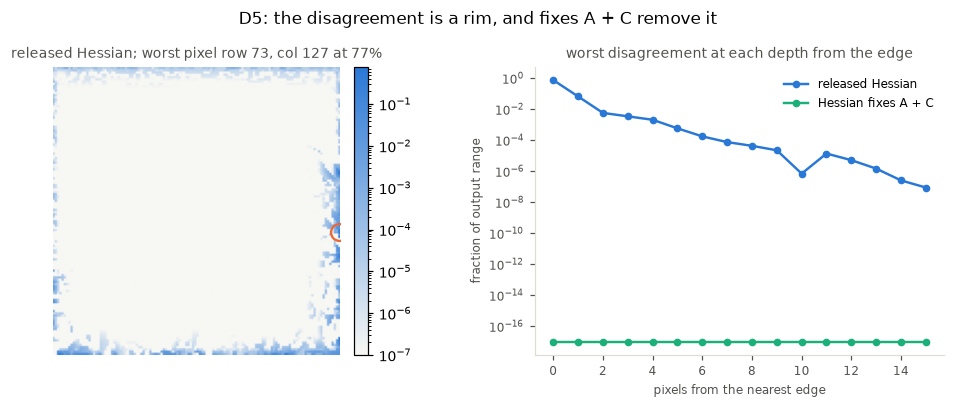
With the released Hessian the disagreement is confined to a rim: about 77% of
the output range at the outermost pixel, an order of magnitude less one pixel
in, and below 1% by the third. With fixes A and C it is zero — not small, zero
to floating point — at every depth, which is the result on_hessian.md reports
for frangi, sato and hessian together. Nothing in frangi itself needs to
change.
7. D6 — alpha does nothing in 2-D¶
The plate-sensitivity factor needs three
eigenvalues. In 2-D the factor does not appear: the pre-fix code sets
r_a = np.inf, and the post-fix code has no 2-D plate term. Either way alpha
cannot affect the result. The docstring describes alpha without
qualification. D6 is present in both states, so the post-fix filter is shown.
ref = frangi_postfix(PHOTO, sigmas=SIGMAS, alpha=0.5, gamma=GAMMA_FIXED)
volume = np.stack([PHOTO[::2, ::2]] * 24, axis=0)
ref3 = frangi_postfix(volume, sigmas=[2], alpha=0.5, gamma=GAMMA_FIXED)
show_table(
    pd.DataFrame(
    [{"alpha": a,
      "2-D: max |diff| vs alpha=0.5":
          np.abs(frangi_postfix(PHOTO, sigmas=SIGMAS, alpha=a,
                                gamma=GAMMA_FIXED) - ref).max(),
      "3-D: max |diff| vs alpha=0.5":
          np.abs(frangi_postfix(volume, sigmas=[2], alpha=a,
                                gamma=GAMMA_FIXED) - ref3).max()}
     for a in (0.1, 2.0, 5.0)]).set_index("alpha").round(6)
)Exactly zero in 2-D, non-zero in 3-D. This is a docstring fix, not a code fix:
add “has no effect for 2-D images” to the alpha entry.
8. How often, and how big¶
Three greyscale images from skimage.data, downsampled so the longest side
is about 200 px. mean ratio is the mean of the reversed-sigmas output over the
mean of the ascending one. top 1% overlap is the Jaccard index of the two
sets of pixels above each run’s own 99th percentile — agreement about which
pixels respond most, with each run allowed its own scale.
def as_grey(image):
    """Greyscale float, downsampled so the longest side is about 200 px."""
    if image.ndim == 3:
        image = ski.color.rgb2gray(image)
    image = ski.util.img_as_float(image)
    return image[:: max(1, max(image.shape) // 200), :: max(1, max(image.shape) // 200)]


CORPUS = {"camera": as_grey(ski.data.camera()),
          "retina": as_grey(ski.data.retina()),
          "coins": as_grey(ski.data.coins())}


def top_overlap(a, b, pct=99):
    """Jaccard index of the two sets of pixels above their own percentile."""
    hot_a, hot_b = a >= np.percentile(a, pct), b >= np.percentile(b, pct)
    return np.logical_and(hot_a, hot_b).sum() / np.logical_or(hot_a, hot_b).sum()


summary = []
for name, image in CORPUS.items():
    asc = frangi_prefix(image, sigmas=SIGMAS)
    desc = frangi_prefix(image, sigmas=SIGMAS[::-1])
    summary.append({
        "image": name,
        "D3 mean ratio": round(desc.mean() / max(asc.mean(), 1e-12), 1),
        "D3 top 1% overlap": round(top_overlap(asc, desc), 3),
        "D4 one distant pixel":
            f"{far_field(lambda im: frangi_prefix(im, sigmas=SIGMAS), image):.1%}",
    })
show_table(pd.DataFrame(summary).set_index("image"))Every image is affected by D3 and D4, and D3’s effect is not a rescaling that a downstream threshold could absorb: the strongest-responding 1% of pixels under the two orderings barely overlap.
D1 is not in this table because a corpus of photographs is the wrong place to measure it: §2.1 found it firing on two pixels of one image at one scale. It is a property of exact ridges, so it is measured where it lives.
polarity = []
for width in (1.0, 2.0, 4.0, 8.0):
    ridge = np.exp(-((cols - 64) ** 2) / (2 * width**2))
    g = np.sqrt((eigen_pair(ridge, 3) ** 2).sum(0)).max() / 2
    polarity.append({
        "ridge width": width,
        "pre-fix, wrong polarity": single_scale(prefix_parts, ridge, 3, g, True)[centre],
        "post-fix, wrong polarity": single_scale(postfix_parts, ridge, 3, g, True)[centre],
        "post-fix, right polarity": single_scale(postfix_parts, ridge, 3, g, False)[centre],
    })
show_table(pd.DataFrame(polarity).set_index("ridge width").round(6))9. Comparators¶
No other implementation makes all of these choices, and each of the four in-filter defects is contradicted by at least one of them.
| implementation | wrong-sign rejection (D1) | σ normalisation (D2) | structuredness threshold / order (D3, D4) |
|---|---|---|---|
| Frangi et al. (1998) | explicit sign branch in Eqs. (13) and (15) | derivatives defined as | is “half the value of the maximum Hessian norm” |
ITK HessianToObjectnessMeasureImageFilter | explicit signConstraintsSatisfied test, then zero | SetNormalizeAcrossScale(true) on the Hessian filter — Lindeberg γ = 1 | a fixed user parameter, never computed from the image; Gamma == 0 disables the term |
DIPlib FrangiVesselness | — | a single-scale primitive that leaves eq. (2) to the caller: scale the input by σ² and its c is the paper’s (§9.1) | not image-derived |
| Jerman’s own MATLAB (source) | explicit Lambda3 <= 0 test | c = sigma.^2; Hxx = c*Hxx; ... — σ² on the Hessian | tau * max(Lambda3(:)), per scale |
skimage PR #8074 (jerman) | explicit lambda3 <= eigval_tol test | none — drops the reference’s σ², but the response is ratio-only so this is inert | tau * lambda3.max(), per scale, inside the loop |
OpenCV ximgproc::RidgeDetectionFilter | — | single fixed ksize, no scale loop | — |
skimage frangi, pre-fix | clipped divide, defeated when | none | s.max()/2 at sigmas[0], frozen |
skimage frangi, post-fix | explicit sign test, as ITK and Jerman | on the Hessian norm | gamma=None resolved over every scale; a fixed user parameter when given |
Two things follow from that table.
ITK is the cleanest contradiction of D3 and D4 together: γ is a parameter the
caller sets, so there is no image statistic in the loop and no order to depend
on. Everyone who does derive a threshold from the image — Jerman, and the
proposed skimage port of it — derives it per scale, which is on_meijering.md’s
defect rather than this one. Nobody freezes one at an arbitrary scale.
The proposed jerman filter is worth flagging on its own account, though only
for half of what it first appears. Its reference implementation multiplies the
Hessian by sigma.^2 and the PR does not, which reads as D2 arriving in a new
filter. It is not a response change while the eigenvalues stay clear of the
PR’s absolute eigval_tol: jerman_vesselness.md §3 shows that the response
depends on its eigenvalues only through their ratio. The omission is therefore
conditionally inert, not unconditionally so.
What does carry over is the other half: jerman recomputes
tau * lambda3.max() inside the scale loop, so it would be a second filter
with meijering’s non-locality. Measured there at 92% under this section’s
far-field probe.
# sato is the in-repo control: same module, same loop, no image statistic.
print("max |ascending - reversed| over sigmas")
for name, fn in (("meijering", meijering), ("sato", sato),
                 ("frangi pre-fix", frangi_prefix),
                 ("frangi post-fix", frangi_postfix)):
    kw = {"mode": "reflect"} if name == "sato" else {}
    delta = np.abs(fn(PHOTO, sigmas=SIGMAS, **kw)
                   - fn(PHOTO, sigmas=SIGMAS[::-1], **kw)).max()
    print(f"  {name:<16}{delta:.4f}")
max |ascending - reversed| over sigmas
meijering 0.0000
sato 0.0000
frangi pre-fix 0.9994
frangi post-fix 0.0000
9.1 Measured against ITK and DIPlib¶
The table above is read from documentation and source. This section runs the
two libraries. It needs diplib and itk, neither of which is a dependency of
anything else here.
# `diplib` registers an IPython input hook on import, reaching for a submodule
# that a plain `import IPython` does not load.  Importing it first is the shim.
import IPython.terminal.pt_inputhooks  # noqa: F401

import diplib as dip
import itk
DIPlib -- a quantitative image analysis library
Version 3.6.1 (Jun 27 2026)
For more information see https://diplib.org
Both are single-scale and neither derives c from the image, so the
comparable call passes one σ and an explicit γ.
Equation (2) folds the scale normalisation into the definition of the
derivative, so the of eq. (12) already carries , is already
normalised, and is a threshold on that. Our gamma is that . The
question for each library is only where it puts eq. (2). ITK has it as a
switch, SetNormalizeAcrossScale; with the switch on, its γ is ours with no
factor anywhere. DIPlib leaves it to the caller — which is why its response
falls monotonically with σ — so hand it the image times and its
is ours too.
Dividing by instead would be the same arithmetic, since scaling the input scales and leaves the blobness ratio alone. Scaling the input is the better statement of it: one threshold, both sides normalised.
ITK_OUT = itk.Image[itk.F, 2]


def itk_vesselness(image, sigma, gamma, beta=0.5, normalize=True):
    """ITK's `HessianToObjectnessMeasureImageFilter`, for a 2-D line."""
    handle = itk.GetImageFromArray(np.ascontiguousarray(image, dtype=np.float32))
    hessian = itk.HessianRecursiveGaussianImageFilter.New(handle)
    hessian.SetSigma(sigma)
    hessian.SetNormalizeAcrossScale(normalize)
    hessian.Update()
    # The output pixel type must be named: left to the wrapper it defaults to
    # int16, which truncates the measure to 0 and 1.
    measure = itk.HessianToObjectnessMeasureImageFilter[
        type(hessian.GetOutput()), ITK_OUT
    ].New()
    measure.SetInput(hessian.GetOutput())
    measure.SetAlpha(0.5)
    measure.SetBeta(beta)
    measure.SetGamma(gamma)
    measure.SetObjectDimension(1)      # a line
    measure.SetBrightObject(True)
    measure.SetScaleObjectnessMeasure(False)   # an ITK extension, not Frangi's
    measure.Update()
    return itk.GetArrayFromImage(measure.GetOutput())


def dip_vesselness(image, sigma, gamma, beta=0.5):
    """DIPlib's `FrangiVesselness`.  Its 2-D `parameters` is [beta, c]: it has
    no alpha, exactly as eq. (15) has no plate factor."""
    return np.asarray(dip.FrangiVesselness(
        image, sigmas=[sigma], parameters=[beta, gamma], polarity='white'))


def repaired(image, sigma, gamma, power=2.0):
    """One scale of the repaired filter, from §2.2's and §4.2's pieces.

    `frangi_fixed` of §10.1 is this with the scale loop around it; it is not
    defined yet at this point in the notebook.
    """
    cached = frangi_cache(image, [sigma], parts_fn=postfix_parts, power=power,
                          black_ridges=False)
    return fuse(cached, gamma).max(0)
C, BETA = 0.05, 0.5
MARGIN = (slice(40, -40),) * 2 # clear of each library's boundary rule
scene = ski.util.img_as_float(ski.data.camera())[::2, ::2][:160, :160]
rows = []
for sigma in (1.0, 2.0, 3.0, 6.0):
ours = repaired(scene, sigma, C)
for name, theirs in (
("ITK, normalised", itk_vesselness(scene, sigma, C, BETA)),
("DIPlib, on sigma**2 * image",
dip_vesselness(scene * sigma**2, sigma, C, BETA))):
gap = np.abs(ours[MARGIN] - theirs[MARGIN])
span = max(ours[MARGIN].max(), 1e-12)
rows.append({"sigma": sigma, "against": name,
"max difference": f"{gap.max():.1e}",
"of range": f"{gap.max() / span:.1%}",
"median": f"{np.median(gap):.0e}",
"pixels over 1%": f"{(gap > 0.01 * span).mean():.2%}"})
show_table(pd.DataFrame(rows), index=False)The median is zero and only a fraction of a per cent of pixels move by more
than 1%: the bulk agrees exactly, and the residue is the handful of pixels
where an eigenvalue sign is near-degenerate, plus each library’s own Gaussian.
frangi is the same filter these two are.
9.2 Three independent readings of the exponent¶
The matching above assumed the exponent is 2. That is testable, and all three ways of asking put it at exactly that. The scan below divides rather than scaling the input, because a scan wants one thing varying: dividing by is the same arithmetic as scaling the input by , and reads better when is not 2.
ridge_scene = np.exp(-((cols - 64) ** 2) / (2 * 4.0**2))
SIGMA_ONE = 3.0

scan = []
for power in (1.5, 1.8, 2.0, 2.2, 2.5):
    ours = repaired(ridge_scene, SIGMA_ONE, C)
    theirs = dip_vesselness(ridge_scene, SIGMA_ONE, C / SIGMA_ONE**power, BETA)
    gap = np.abs(ours[MARGIN] - theirs[MARGIN]).max()
    scan.append({"DIPlib c divided by": f"sigma ** {power}",
                 "max difference": f"{gap:.1e}",
                 "of range": f"{gap / ours[MARGIN].max():.1%}"})
show_table(pd.DataFrame(scan), index=False)# ITK has the normalisation as a switch, so it can be asked directly: is
# `NormalizeAcrossScale(True)` the same as dividing `c` by sigma ** 2?
direct = []
for sigma in (2.0, 3.0):
switched = itk_vesselness(scene, sigma, C, BETA, normalize=True)
scaled = itk_vesselness(scene, sigma, C / sigma**2, BETA, normalize=False)
# and the Hessian itself, normalised over plain
handles = []
for flag in (False, True):
h = itk.HessianRecursiveGaussianImageFilter.New(
itk.GetImageFromArray(np.ascontiguousarray(scene, dtype=np.float32)))
h.SetSigma(sigma)
h.SetNormalizeAcrossScale(flag)
h.Update()
handles.append(itk.GetArrayFromImage(h.GetOutput())[..., 0])
live = np.abs(handles[0]) > 1e-6
direct.append({
"sigma": sigma,
"switch vs c / sigma**2": f"{np.abs(switched - scaled).max():.0e}",
"ITK normalised / plain Hessian":
f"{np.median(handles[1][live] / handles[0][live]):.4f}",
"sigma ** 2": sigma**2,
})
show_table(pd.DataFrame(direct), index=False)So: DIPlib’s own responses pick out 2.0 with a sharp minimum; ITK’s
NormalizeAcrossScale switch is indistinguishable from dividing by
; and ITK’s normalised Hessian is its plain one times exactly
. The exponent in §10’s repair is not a preference.
10. Ways forward¶
Each defect has a small repair. Put together they are one function, and the order in which they are adopted matters — §10.2.
10.1 The four repairs, in one implementation¶
def frangi_fixed(image, sigmas, gamma=None, power=2.0, beta=0.5,
                 black_ridges=True, mode="reflect"):
    """`frangi` with D1, D2 and D3 repaired.

    power : float
        The Lindeberg exponent, 2 * gamma_L. 2.0 selects a ridge at w*sqrt(2);
        1.5 selects it at w. 0.0 is the pre-fix behaviour (no selection).
    """
    cached = frangi_cache(image, sigmas, parts_fn=postfix_parts, power=power,
                          black_ridges=black_ridges, mode=mode)      # D1
    if gamma is None:
        gamma = resolved_gamma(cached)                               # D3
    return fuse(cached, gamma).max(0)
D1 is
postfix_parts: an explicit sign test rather than a clipped divide.D2 is
power, a factor folded into the eigenvalues.D3 is
resolved_gamma, computed from the cache after the loop.D4 has no repair that keeps
gamma=None; passinggammaexplicitly is the only local option, and that is a documentation change.D5 is
on_hessian.md’s fixes A and C, inhessian_matrix, not here.D6 is a docstring line.
wide6 = np.exp(-((strip_cols - MIDDLE[1]) ** 2) / (2 * 6.0**2))


def scale_won(power, gamma=0.2):
    """Which sigma wins at the centre of a width-6 ridge, at this exponent."""
    scores = {}
    for sigma in SIGMA_GRID:
        blobness, norm = postfix_parts(-wide6, sigma, power=power)
        scores[sigma] = (blobness * (1 - np.exp(-norm**2 / (2 * gamma**2))))[MIDDLE]
    return max(scores, key=scores.get)


checks = {}
for label, fn, parts_fn, power in (
        ("pre-fix", lambda im, sg: frangi_prefix(im, sigmas=sg), prefix_parts, 0.0),
        ("D1+D3 (power=0)",
         lambda im, sg: frangi_fixed(im, sg, power=0.0), postfix_parts, 0.0),
        ("all (power=2)",
         lambda im, sg: frangi_fixed(im, sg, power=2.0), postfix_parts, 2.0),
        ("all (gamma=0.5)",
         lambda im, sg: frangi_fixed(im, sg, gamma=0.5), postfix_parts, 2.0)):
    checks[label] = {
        "D1 wrong polarity (want 0)":
            f"{single_scale(parts_fn, bright, 3, GAMMA_DEMO, True)[centre]:.4f}",
        "D2 sigma winning a w=6 ridge": scale_won(power),
        "D3 order spread (want 0)":
            f"{max(np.abs(fn(PHOTO, p) - fn(PHOTO, TRIO)).max() for p in permutations(TRIO)):.4f}",
        "D4 far field (want 0%)":
            f"{far_field(lambda im: fn(im, SIGMAS), PHOTO):.1%}",
    }
show_table(pd.DataFrame(checks).T)10.2 D2 and D3 must be fixed together¶
§4.2 showed that hoisting γ is a silent no-op for an ascending sigmas,
because the largest Hessian norm sits at the smallest σ. Applying the σ power
destroys that property: peaks wherever the image’s
dominant structure lives, which need not be the finest scale.
where_peak = []
for name, image in CORPUS.items():
    for power in (0.0, 2.0):
        norms = {s: postfix_parts(image, s, power=power)[1].max() for s in SIGMAS}
        where_peak.append({"image": name, "power": power,
                           "sigma with the largest S": max(norms, key=norms.get)})
show_table(
    pd.DataFrame(where_peak).pivot(index="image", columns="power",
                               values="sigma with the largest S")
)With power=0 the peak is at σ = 1 on every image, so sigmas[0] and the true
maximum coincide for a sorted list and the ordering bug is invisible. With
power=2 they part company on some images. Fixing D2 alone would therefore
make D3 worse — the frozen γ would be taken from a scale that is no longer
even close to the maximum. D3 is the cheaper fix and should land first, or in
the same change.
10.3 What the repairs cost¶
import time

costs = []
for label, fn in (("pre-fix", lambda: frangi_prefix(PHOTO, sigmas=SIGMAS)),
                  ("D1+D3 (power=0)", lambda: frangi_fixed(PHOTO, SIGMAS, power=0.0)),
                  ("all (power=2)", lambda: frangi_fixed(PHOTO, SIGMAS, power=2.0))):
    started = time.perf_counter()
    for _ in range(3):
        out = fn()
    costs.append({"candidate": label,
                  "seconds": round((time.perf_counter() - started) / 3, 3),
                  "max |diff| vs pre-fix":
                      f"{np.abs(out - frangi_prefix(PHOTO, sigmas=SIGMAS)).max():.3g}"})
show_table(pd.DataFrame(costs).set_index("candidate"))D1 and D3 together cost nothing in time — the same number of Hessian
evaluations — and change the photograph’s output by about on
an ascending sigmas list. The residue is not exactly zero, and §2.1 says why:
it is the D1 leak firing at σ = 9 on the two pixels where has
fallen below the threshold. The change is that small because those pixels also
carry a tiny , so the structuredness gate had nearly closed on them anyway.
On synthetic ridges the same two fixes change the answer completely, which is
the point.
D2 changes everything, on every image, by design: it is the difference between a filter that can select a ridge’s width and one that collapses non-trivial vesselness onto the finest scale. That is a behaviour change to announce, not a silent bug fix, and it is what #7711 is asking for.
11. What not to do¶
Do not recompute γ at every scale¶
It removes the order dependence and it is the smaller diff. It also hands every
scale a different divisor, which §5.1 measured as moving the winning scale at
45% of the pixels with , against the 18% of that same set moved by
the order effect it repairs — a larger defect in exchange for a smaller one,
and precisely the one on_meijering.md is about. The far-field probe confirms
it stays non-local.
per_scale = lambda im: fuse(frangi_cache(im, SIGMAS, parts_fn=prefix_parts),
                            "per-scale").max(0)
print(f"γ per scale: far field {far_field(per_scale, PHOTO):.2%}")

edited = PHOTO.copy()
edited[0, 0] = 10.0
far = (slice(100, None), slice(100, None))
print("brighten one pixel at (0, 0); winning sigma more than 100 px away")
for gamma, label in (("per-scale", "γ per scale"), (max(gammas.values()), "γ hoisted")):
    before = winning_sigma_map(PHOTO, SIGMAS, gamma)
    after = winning_sigma_map(edited, SIGMAS, gamma)
    print(f"  {label:<14}changed for {np.mean(before[far] != after[far]):.1%} of far pixels")
γ per scale: far field 82.55%
brighten one pixel at (0, 0); winning sigma more than 100 px away
γ per scale changed for 19.9% of far pixels
γ hoisted changed for 0.0% of far pixels
Do not just sort sigmas inside the function¶
Sorting makes the output a function of the set again, satisfying the docstring in one line. It also promotes the pre-fix accident — “use the smallest scale’s contrast reference” — into a decision, without anyone deciding it. And §10.2 shows it stops being equivalent to the docstring’s own wording as soon as D2 lands.
Do not read D1 as harmless because photographs are nearly unaffected¶
§2.1 found two leaking pixels in 65536, at one scale of one photograph. That is
a statement about photographs, not about the filter. Every ridge with a straight
segment has along it, exactly, and those are the structures
frangi exists to find; on them the leak is total, not marginal. The defect is
narrow in the space of images and central in the space of ridges.
The near-miss is itself a warning about method. A single-scale census said zero
and would have supported “never”; the scan over sigmas found the exception,
because falls as σ grows. Any claim of the form “this cannot
happen on real data” needs the sweep, not the sample.
Do not treat D5 as a frangi bug¶
The rim in §6 is hessian_matrix’s, shared with sato and hessian, and
fixing it inside frangi would leave the other two wrong. on_hessian.md
fixes A and C remove it at source, and §6 measures them doing so.
12. Summary¶
| defect | what breaks | evidence | repair |
|---|---|---|---|
| D1 | black_ridges is inert on an ideal ridge; wrong-polarity ridges score the filter’s maximum | §2, identical arrays for both settings; §2.1 leak census over σ; §8 polarity table | explicit sign test, as ITK and Jerman do |
| D2 | ideal ridges never select their own width under the pre-fix unnormalised structuredness term; non-trivial vesselness collapses to the finest σ in the tested regime | §3, analytic falloff; high- photo scan; peaks under Lindeberg powers | on the Hessian; #7711 |
| D3 | output depends on the order of sigmas | §4, three permutation classes keyed by sigmas[0] | resolve γ before the loop |
| D4 | gamma=None makes output depend on pixels arbitrarily far away | §5, far-field probe, zero once gamma is explicit | document the published global- heuristic, or require a local threshold |
| D5 | a bright rim, large relative to the output range | §6, disagreement with a once-extended reference | on_hessian.md fixes A and C |
| D6 | alpha is documented and inert in 2-D | §7, exactly zero difference in 2-D, non-zero in 3-D | one docstring line |
The repairs above are implemented in the frangi-fixes branch, and
frangi_postfix in §1 is their transcription. The pre-fix transcription is
frangi_prefix. The notebook runs against either installation and gives the
same result, because every measurement comes from one of those two functions.
§1’s state cell reports which of the two the installed frangi matches.
Recommended order. D3 first: it is one line, it is exactly
back-compatible for sorted sigmas, and it is a prerequisite for D2 behaving
sensibly. Then D1 and D6, both small and both fixing a stated contract. Then D2
as an announced behaviour change, with the exponent chosen deliberately.
on_meijering.md §8 separates the detection map from the width map, and §9
compares the choice with ITK and DIPlib: the detection map takes sigma**2 in
both filters, and gamma = 3/4 is a width-map calibration. The two filters
answer the same question the same way. D4 is documentation. D5 belongs to
hessian_matrix.
Limits. Three 2-D greyscale images from skimage.data, downsampled to
about 200 px; sigmas = (1, 3, 5, 7, 9), mode='reflect', default beta;
permutation scans use the first three scales, not the full list. The scale-
selection measurements in §3 use ideal Gaussian ridges, where
vanishes exactly; curved and finite-length ridges are not tested, and the D1
leak census in §2.1 covers those five σ on one photograph, so “vanishingly
rare” is a statement about that scan and not a bound. 3-D frangi
appears only in §7 — D1 and D3 apply there by inspection of the shared code
path, but that is a reading rather than a measurement here.
The notebook was executed against two installations of scikit-image: a pre-fix
build at aac0f792a and the repaired frangi-fixes tip at 275a586a3. Both
runs give the same output, cell for cell, because every result comes from
frangi_prefix or frangi_postfix.
print(f"scikit-image {ski.__version__}")scikit-image 0.26.1rc0.dev0
- Frangi, A. F., Niessen, W. J., Vincken, K. L., & Viergever, M. A. (1998). Multiscale vessel enhancement filtering. In Medical Image Computing and Computer-Assisted Intervention — MICCAI’98 (pp. 130–137). Springer Berlin Heidelberg. 10.1007/bfb0056195